
Could Using Nitrogen Instead of Helium Be a Cost-Effective Alternative for Floating Balloons?
Helium prices are soaring, making you search for cheaper options. But the wrong choice could leave your balloons grounded. Let's explore if nitrogen is a smart, cost-effective alternative.
No, nitrogen is not a cost-effective alternative1 for floating balloons. Its density is nearly the same as air, so it cannot provide the necessary lift. A nitrogen-filled balloon2 will not float, acting just like a balloon filled with regular air from your lungs.
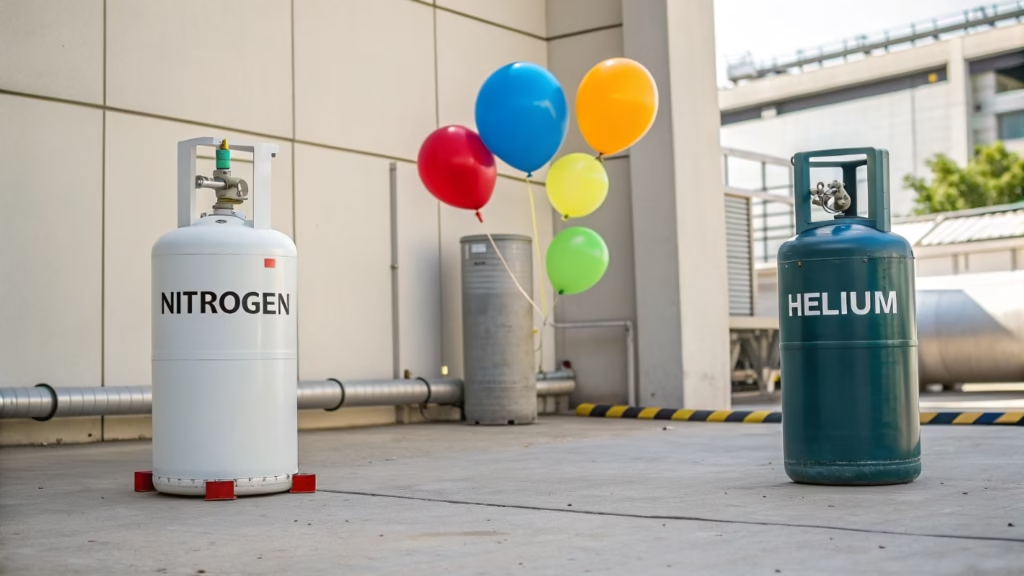
The idea of a cheaper gas is tempting, right? As a balloon procurement manager3, I've seen costs rise and have explored every possible alternative to stay competitive. The question about nitrogen comes up often, and it's rooted in a smart desire to manage budgets. But before we write it off, it's important to understand the "why" behind the answer. Let's break down the science, the costs, and the safety to see the full picture and understand why some things in physics just can't be negotiated.
What is the lifting capacity of nitrogen compared to helium in balloons?
Need your balloons to soar high for a big event? Using the wrong gas could leave them grounded, ruining the visual effect and disappointing clients. Let's compare the lifting power.
Nitrogen has virtually zero lifting capacity in a balloon because its density is almost identical to the air around it. In contrast, helium is about seven times lighter than air, which gives it the strong lifting power needed for floating balloons.
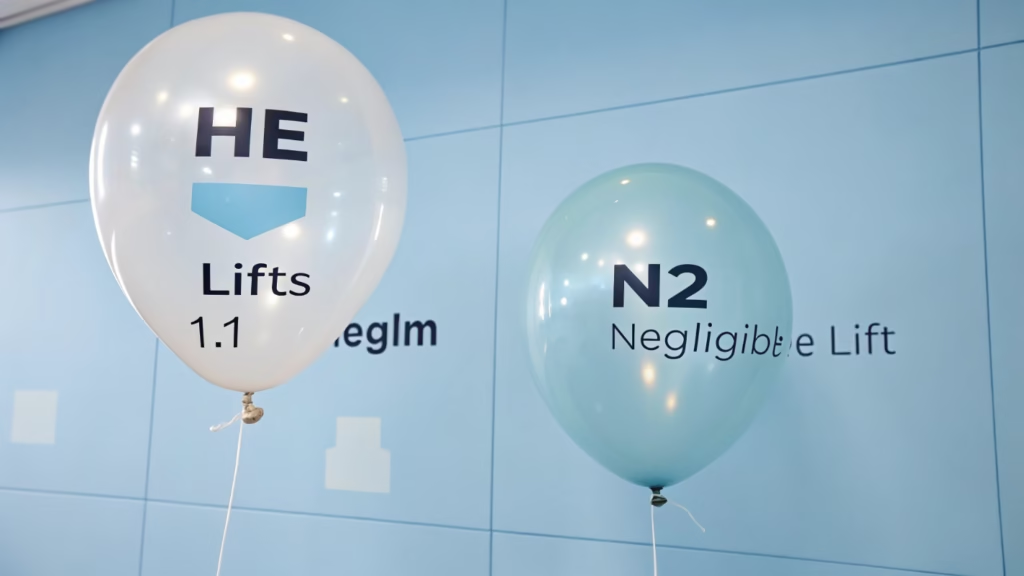
The ability of a balloon to float comes down to a simple principle: the gas inside must be significantly lighter, or less dense, than the air outside. Think of it like a boat in water; the boat floats because it is less dense than the water it displaces. The same idea applies to balloons in the air.
The Science of Density
Helium is the second lightest element in the universe. Its low atomic mass makes it much less dense than the mixture of gases that make up our air. Nitrogen, on the other hand, is the main component of the air we breathe, making up about 78% of it. Because of this, its density is almost exactly the same as air.
A Quick Comparison
Let’s look at the numbers to see the difference clearly. Lifting power is measured by how much weight a cubic meter of gas can lift.
| Gas | Density (at 0°C) | Approx. Lifting Power per Cubic Meter |
|---|---|---|
| Helium | 0.1785 kg/m³ | ~1.1 kg |
| Nitrogen | 1.2506 kg/m³ | ~0.04 kg (negligible) |
| Air | 1.2922 kg/m³ | 0 kg (neutral) |
As you can see, nitrogen provides almost no lift. A balloon filled with nitrogen will just sit on the floor. I remember a new team member once tried it in our warehouse to save on helium for a test. The result was a bunch of beautiful but very grounded balloons.
How do the bulk purchasing costs of nitrogen and helium compare for commercial use?
Your budget is tight, and you see helium prices4 keep climbing. You might be tempted by the much lower price tag of other industrial gases like nitrogen. Let's look at the costs.
Nitrogen is significantly cheaper to purchase in bulk than helium. However, this cost advantage is irrelevant for floating balloons because nitrogen does not provide lift. Spending any money on nitrogen for floating purposes is essentially a waste.

When managing procurement for large retailers, cost is always a top priority. On paper, switching from helium to nitrogen looks like a brilliant cost-saving move. Nitrogen is one of the most abundant gases on Earth, making it inexpensive to produce and acquire. Helium, however, is a finite resource that must be extracted from the ground, and its supply is limited, driving prices up. A large cylinder of nitrogen might cost only a fraction of what a similar-sized cylinder of helium costs.
The Cost vs. Functionality Trap
The problem is that you are not just buying a gas; you are buying a function—the ability to make a balloon float. Since nitrogen cannot perform this function, its lower price is a moot point. It's like buying bicycle tires for your car because they are cheaper; they don't fit and they won't work, so the money is wasted.
Calculating the True Cost
The true cost of a product is its price divided by its utility.
- Helium: High price, but it works perfectly. It delivers the desired floating effect, making customers happy and events successful. The cost is justified by the result.
- Nitrogen (for floating): Low price, but zero utility. It fails to deliver the floating effect. Therefore, any money spent is a 100% loss for this specific purpose.
In my role, I've learned that focusing only on the purchase price can lead to costly mistakes. The "effective cost" of using nitrogen to float balloons is infinite because it simply cannot do the job.
Are there specific safety regulations for filling and transporting nitrogen balloons?
You always put safety first, especially when handling compressed gases5. You wonder if using a different gas like nitrogen comes with its own set of rules. Let's check the safety regulations6.
Yes, there are safety regulations for handling any compressed gas, including nitrogen. It must be stored and transported in approved, high-pressure cylinders. The main risk with nitrogen in enclosed spaces is asphyxiation, as it can displace oxygen.
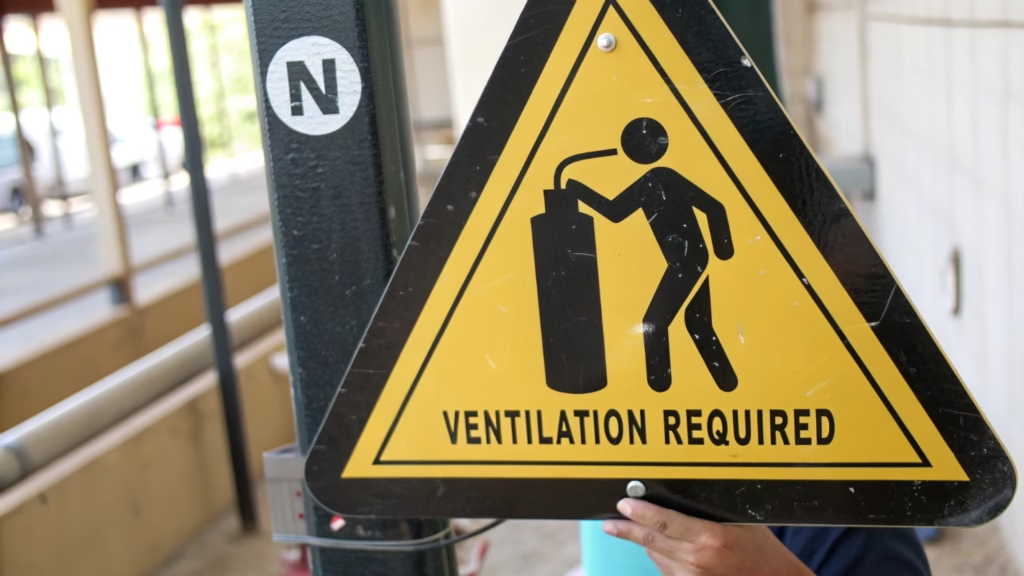
Even though nitrogen won't make your balloons float, it's still an industrial gas that requires careful handling. At AIHUA BALLOON, we adhere to strict international safety standards like Sedex and ISO9001 for all materials we work with, and that includes any gas used in our facilities.
Handling and Storage
Nitrogen, like helium, is stored in highly pressurized cylinders. These tanks are heavy and can be dangerous if mishandled.
- Secure Transport: Cylinders must always be secured with chains or straps during transport to prevent them from falling over and damaging the valve.
- Proper Ventilation: When filling balloons, the area must be well-ventilated. Although nitrogen is not toxic, it can displace oxygen in a room. If the concentration of nitrogen becomes too high, it can lead to dizziness, unconsciousness, or worse. This is a primary safety concern.
- Pressure Regulators: Always use a proper pressure regulator designed for nitrogen. Connecting a cylinder directly to a balloon or using the wrong equipment can cause the balloon to burst or the tank to release gas uncontrollably.
I always ensure my teams are trained on these protocols. During a site visit to one of our suppliers, I saw firsthand how a small, poorly ventilated room became a safety hazard during gas testing7. It reinforced my belief that proper procedures are non-negotiable, regardless of which gas you're using.
Where can wholesalers source industrial-grade nitrogen for large-scale events?
You're planning a massive event and need a reliable gas supply. Even if not for floating, maybe you need it for another use. You wonder where to get it.
Wholesalers can source industrial-grade nitrogen8 from major industrial gas suppliers like Airgas, Linde, or Air Products. These companies provide nitrogen in various quantities, from single cylinders to bulk liquid containers, suitable for any large-scale need.
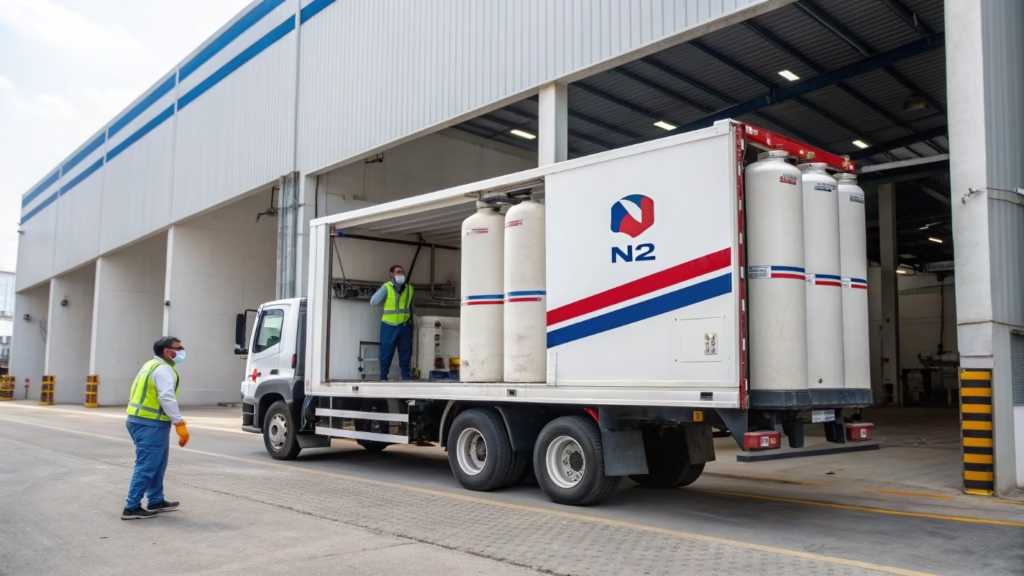
While nitrogen is not the solution for floating balloons, it has many other uses in the event industry9. For example, it's used to create fog or haze effects with liquid nitrogen, or sometimes just to inflate ground-based balloon displays10 that don't need to float. As a procurement manager, building relationships with reliable suppliers is key.
Finding a Supplier
For large-scale events, you need a supplier who can guarantee delivery and quality.
- National Gas Companies: Large suppliers like those mentioned above have distribution networks across the country. They are the most reliable option for bulk orders and can provide the necessary equipment and safety support. I work with them regularly for our helium needs and know they are dependable.
- Local Welding Supply Stores: For smaller or more localized needs, welding supply companies often stock nitrogen and other industrial gases. They can be a good option for last-minute or smaller quantity orders.
- Direct from Producer: In some cases, you may be able to contract directly with a gas production facility if your volume is extremely high, though this is less common for event purposes.
When sourcing, always ask for a Certificate of Analysis11 to ensure you are getting the correct grade of nitrogen for your application. Also, confirm their delivery logistics and emergency supply capabilities. You never want to be left without a critical resource on the day of a big event.
Conclusion
In summary, nitrogen is cheaper than helium but will not make balloons float. For creating buoyant, magical displays, helium remains the only safe and effective choice in the industry.
-
Explore the pros and cons of using nitrogen as a helium substitute for balloons. ↩
-
Learn about the effects of using nitrogen in balloons to avoid costly mistakes. ↩
-
Gain insights into the role of a procurement manager in managing balloon supplies. ↩
-
Stay updated on helium prices to make informed purchasing decisions for your events. ↩
-
Understand the risks of handling compressed gases to maintain a safe working environment. ↩
-
Ensure safety compliance when working with compressed gases in your operations. ↩
-
Learn about gas testing protocols to ensure safety and effectiveness at events. ↩
-
Find reliable suppliers for industrial-grade nitrogen to meet your event needs. ↩
-
Explore the various applications of nitrogen beyond balloon inflation in events. ↩
-
Discover creative uses for nitrogen in balloon displays that don't require floating. ↩
-
Ensure quality and safety by knowing the importance of a Certificate of Analysis. ↩