Do latex balloon manufacturers offer private labeling services?
Struggling to find a balloon supplier that can handle your brand's specific needs? This search can be frustrating, but the right partner makes the process simple and effective.
Yes, most professional latex balloon manufacturers offer private labeling services1. This includes everything from custom balloon printing2 with your logo to fully branded retail packaging3. It is a complete solution to get your unique product onto store shelves quickly and efficiently, strengthening your brand's presence.
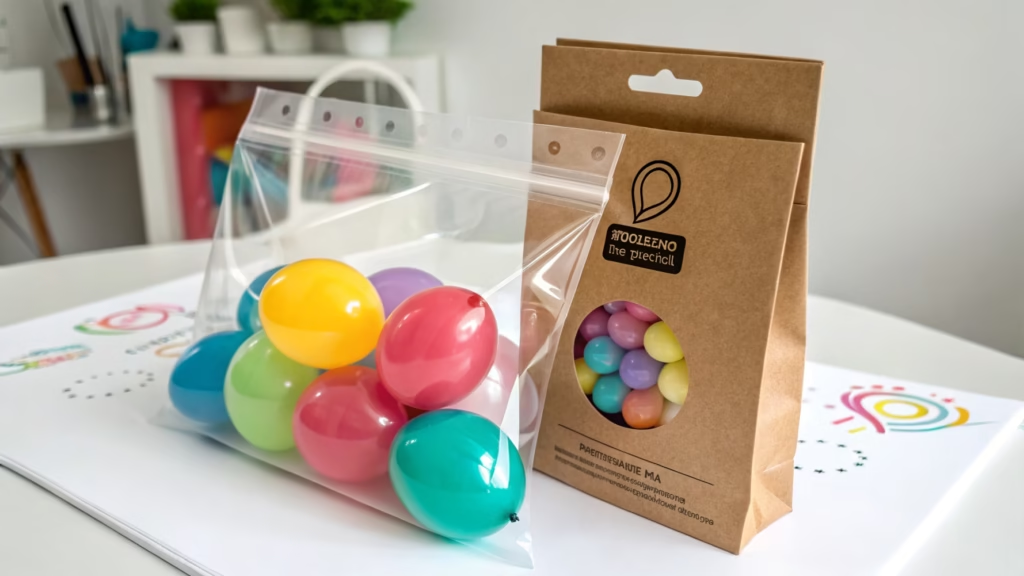
Finding a manufacturer that offers private labeling is just the first step. You need a partner who understands your goals and can deliver on them consistently. My experience in this industry has shown me that a successful private label program is built on a clear understanding of the process, from initial requirements to the final product. Let's explore what you need to know to launch your own branded balloon line and ensure your success in the market.
What are the typical requirements for private label balloon orders?
You want to order custom balloons, but you are not sure what the factory needs. This uncertainty can delay your project and create unnecessary internal planning headaches for your team.
Typically, manufacturers require your brand artwork in a vector file format4, like .AI or .EPS. You will also need to provide specific Pantone (PMS) color codes5 for printing and detailed specifications for the packaging, including any barcodes or required legal warnings.
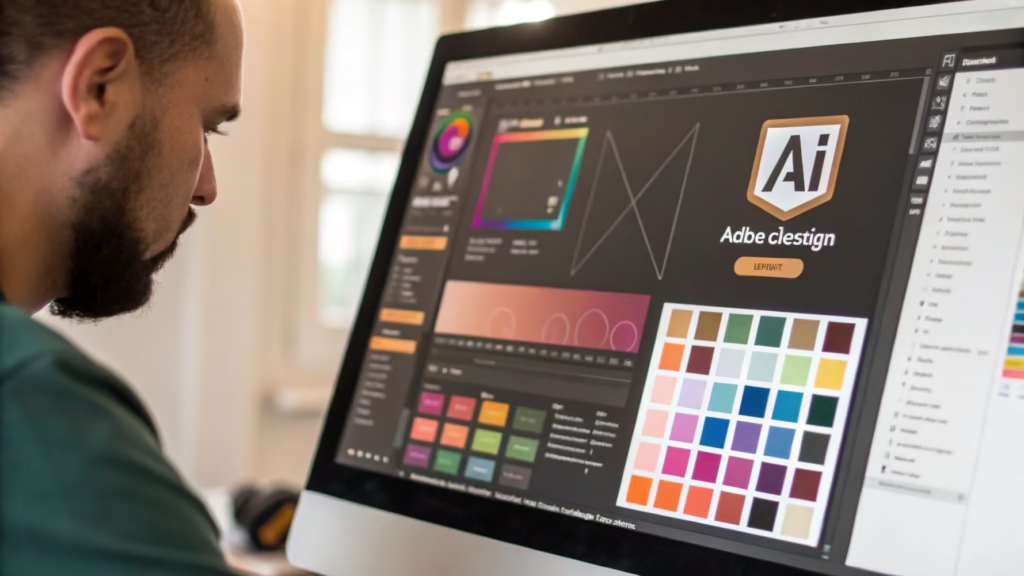
To make the process as smooth as possible, it helps to prepare your assets beforehand. Based on my years of helping procurement managers like yourself, a well-prepared brief is the key to efficiency. When we start a new private label project at AIHUA BALLOON, we ask for a few key items. First, we need your artwork. Vector files are essential because they can be scaled to any size without losing quality, ensuring your logo looks sharp on the balloon. Second, brand color consistency is crucial. Providing Pantone (PMS) codes allows us to match your brand's exact colors. Finally, we need your packaging details. This includes the dieline for the bag or box, barcode information (like a UPC or EAN), and any legally required safety text, such as choking hazard warnings for the US or EU markets. Having these items ready will speed up the entire process.
| Requirement | Description | Why It's Important |
|---|---|---|
| Vector Artwork | Files like Adobe Illustrator (.AI) or .EPS. | Ensures print quality is high and scalable. |
| Pantone Codes | Specific color codes (e.g., PMS 185 C). | Guarantees brand color consistency across all products. |
| Packaging Specs | Dielines, material, barcodes, safety warnings. | Creates retail-ready packaging that meets legal standards. |
| Brand Ownership | Proof might be requested. | Protects both you and the manufacturer from IP issues. |
What customization options exist for balloon printing and packaging?
You need your branded balloons to stand out on crowded store shelves. Generic designs and basic packaging simply will not capture a customer's attention or build your brand's value.
Beyond a simple logo, you can choose one or two-sided printing, full "all-over" wrap designs, and a wide array of ink colors. Packaging can be customized with different materials, finishes like matte or gloss, and features like window cutouts or hang holes.
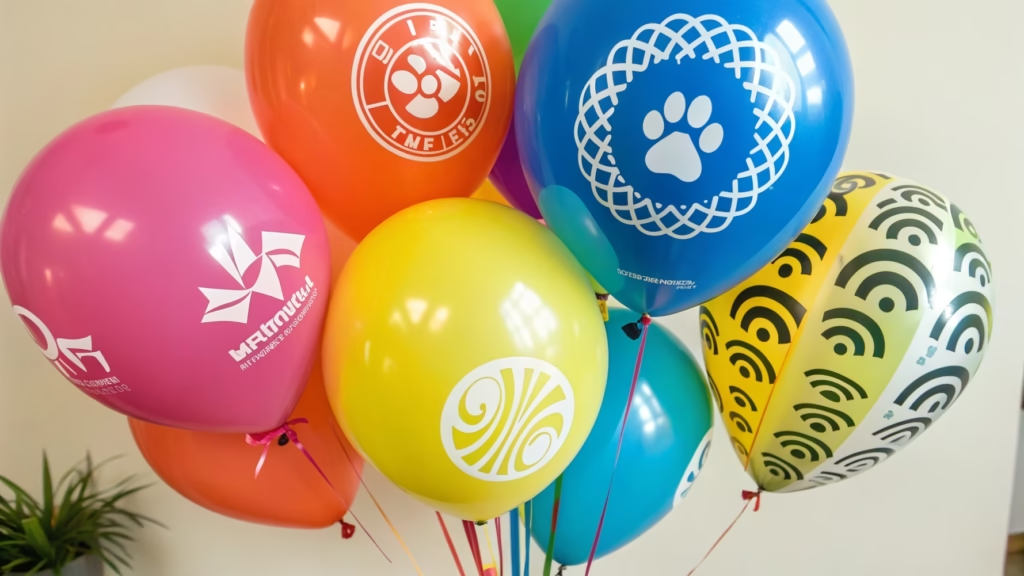
The right customization can make your product fly off the shelves. I always tell my partners that the balloon and its package are their brand's ambassadors in the store. For balloon printing, screen printing is the most common method, allowing for crisp designs with up to eight different colors. We can print on one side, both sides, or even do an all-around print for a continuous pattern. For packaging, the options are just as varied. You can choose a simple polybag with a printed header card, which is cost-effective. Or, you can opt for a custom-printed retail box6 with a clear window that lets customers see the vibrant balloon colors inside. I remember working with a large European retailer who chose a retail box with a matte finish and a window. This premium feel boosted their sales, proving that investing in packaging pays off.
| Customization Area | Standard Option | Premium Option |
|---|---|---|
| Balloon Printing | 1-color, 1-side logo print. | Multi-color, 2-side or all-over pattern. |
| Packaging Material | Standard polybag with header card. | Custom-printed paper box or foil bag. |
| Packaging Finish | No special finish. | Matte, gloss, or UV spot finish. |
| Packaging Feature | Simple seal. | Resealable zip-lock and retail hang hole. |
What is the average minimum order quantity (MOQ) for custom branded balloons?
You are concerned about committing to a massive order for a new custom product. High MOQs can tie up too much capital and create a significant inventory risk for your company.
Minimum Order Quantities (MOQs)7 for custom balloons can vary. For a simple, one-color logo print on a standard balloon color, the MOQ might start around 10,000 units. For fully custom projects with unique balloon colors and bespoke packaging, expect MOQs of 50,000 units or more.
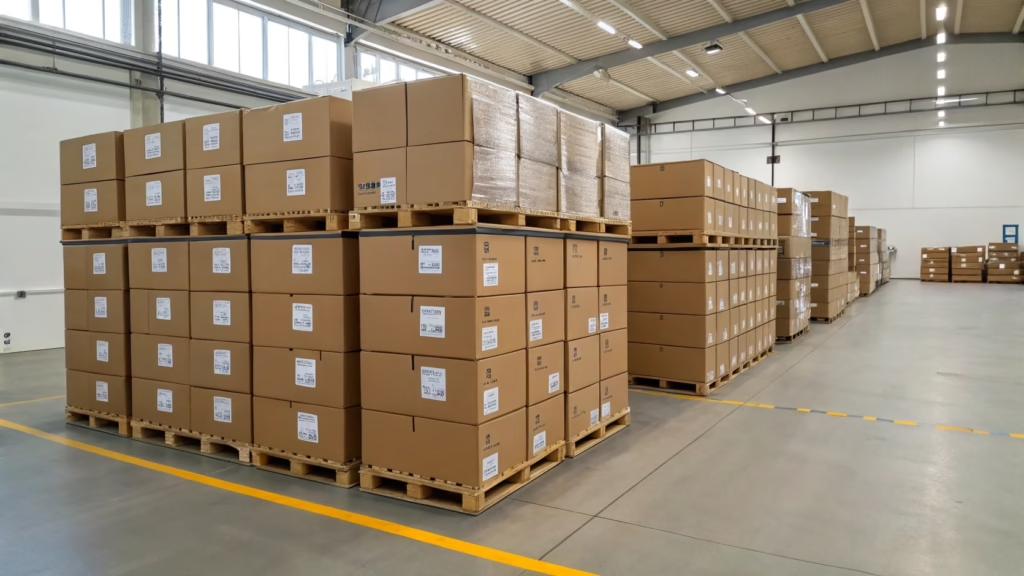
MOQs are in place because of the setup required for custom production runs8. Each new design requires creating new printing screens and configuring machinery, which has a fixed cost. When we produce a custom balloon color, we have to mix a large batch of latex to ensure color consistency, which also drives up the minimum. The same logic applies to packaging—our suppliers have their own MOQs for producing custom-printed bags or boxes. I always advise new partners to start simple if they are concerned about MOQs. For instance, we can print your logo on one of our 90+ standard balloon colors. This keeps the MOQ low. Once the product proves itself in the market, we can move to a more complex order with custom colors and packaging. This phased approach helps you manage risk while still getting your brand into the market.
| Factor | Impact on MOQ | Reason |
|---|---|---|
| Printing | A simple 1-color print has a lower MOQ. | Less setup time and materials are needed. |
| Custom Balloon Color | Significantly increases the MOQ. | Requires a large, dedicated batch of liquid latex. |
| Custom Packaging | Increases the overall MOQ. | Packaging suppliers have their own production minimums. |
| Factory Scale | Larger factories often have higher MOQs. | Production lines are optimized for high-volume runs. |
How can buyers vet and choose a reliable private label balloon partner?
You need a manufacturing partner you can trust for the long term. Choosing the wrong one can lead to quality disasters, missed deadlines, and serious compliance failures that hurt your brand.
Vet potential partners by verifying their factory and social compliance certifications9, such as ISO9001 and Sedex. Always request product samples to check the quality firsthand and ask about their quality control processes10. A transparent and experienced manufacturer is always the most reliable choice.
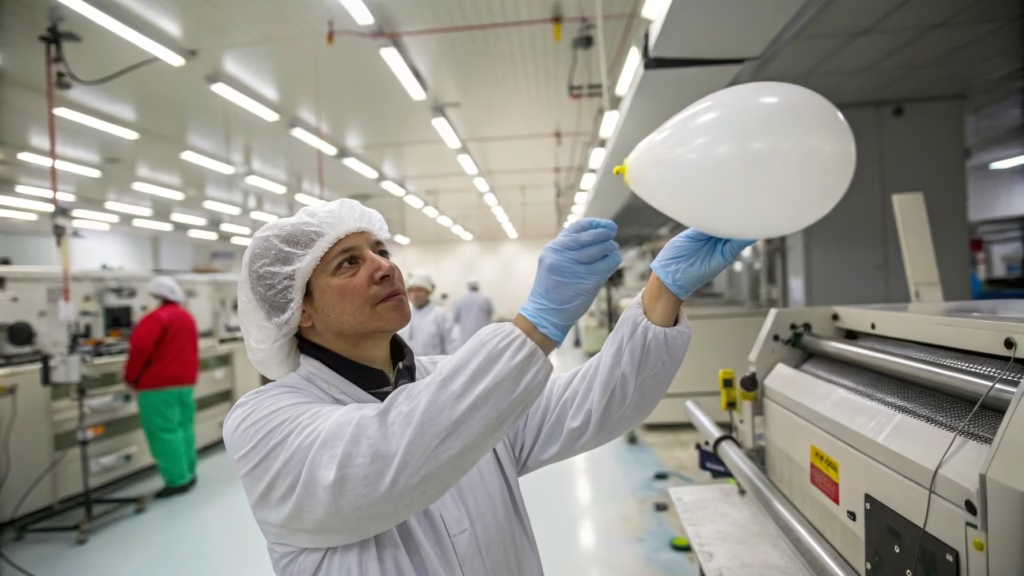
As someone who has built long-term partnerships with major retailers, I know that trust is the foundation of any successful business relationship. Your brand reputation is on the line, so you need a partner who takes quality and ethics as seriously as you do. When vetting a supplier, start with their certifications. At AIHUA BALLOON, we proudly share our Sedex and BSCI reports11, which show our commitment to ethical sourcing, and our ISO9001 certification12, which confirms our quality management systems. Next, get your hands on the product. Request samples to test balloon elasticity, thickness, and color vibrancy. Check the print quality to ensure it is sharp and durable. I also encourage my potential partners to ask tough questions about our quality control. We provide pre-production samples13 for approval and share final inspection reports before shipping. A good partner has nothing to hide and wants you to feel confident before you commit.
Key Vetting Checklist:
- Verify Certifications: Check for active Sedex, BSCI, and ISO 9001 reports.
- Request Samples: Evaluate balloon and print quality yourself.
- Discuss QC Process: Understand how they ensure quality at every stage.
- Assess Communication: Are they responsive, clear, and professional?
- Ask for References: Speak to other buyers they have worked with.
Conclusion
In short, private labeling balloons is a straightforward process with the right factory. Focus on providing clear requirements, explore your many customization options, and properly vet your manufacturer for success.
-
Understanding private labeling helps you leverage existing manufacturing expertise to build your brand faster and more efficiently. ↩
-
Learn about printing techniques to ensure your brand logo appears sharp and professional on every balloon. ↩
-
Stay updated on packaging innovations that can make your product stand out on crowded store shelves. ↩
-
Discover why vector files are essential for scalable, high-quality prints that maintain brand integrity. ↩
-
Learn how Pantone codes guarantee your brand colors are reproduced accurately across all products. ↩
-
Discover how investment in quality packaging can significantly boost product value and sales performance. ↩
-
Learn strategies to manage production costs while maintaining quality standards for new product launches. ↩
-
Understand the cost drivers in custom manufacturing to better plan your production budget and timelines. ↩
-
Learn how certifications protect your brand reputation and ensure ethical manufacturing practices. ↩
-
Learn about comprehensive QC systems that prevent defects and ensure product consistency. ↩
-
Understand how ethical sourcing reports demonstrate a manufacturer's commitment to social responsibility. ↩
-
Discover how quality management systems ensure consistent product excellence and customer satisfaction. ↩
-
Discover how sample approval processes prevent costly mistakes and ensure final product quality. ↩