
How Long Do Balloons Stay Inflated? (Latex vs. Foil)
You inflate a balloon for a party, come back four hours later and it's lying on the floor. Sound familiar? The question "how long do balloons stay inflated" has a deceptively complicated answer — it depends on balloon type, fill method, treatment, temperature, and even altitude. This guide gives you the real numbers so you stop guessing and start planning with confidence.
The difference between a balloon that lasts four hours and one that lasts four days comes down to three things: fill type (helium vs. air), latex treatment (hi-float or standard), and environmental conditions. Master these three variables and you can predict balloon performance every time.
In this guide, I'll break down the exact float times for each balloon type, explain why the same balloon can perform completely differently at the same event in different rooms, and give you the professional rules of thumb for making balloons last through your event without embarrassing mid-party deflation.
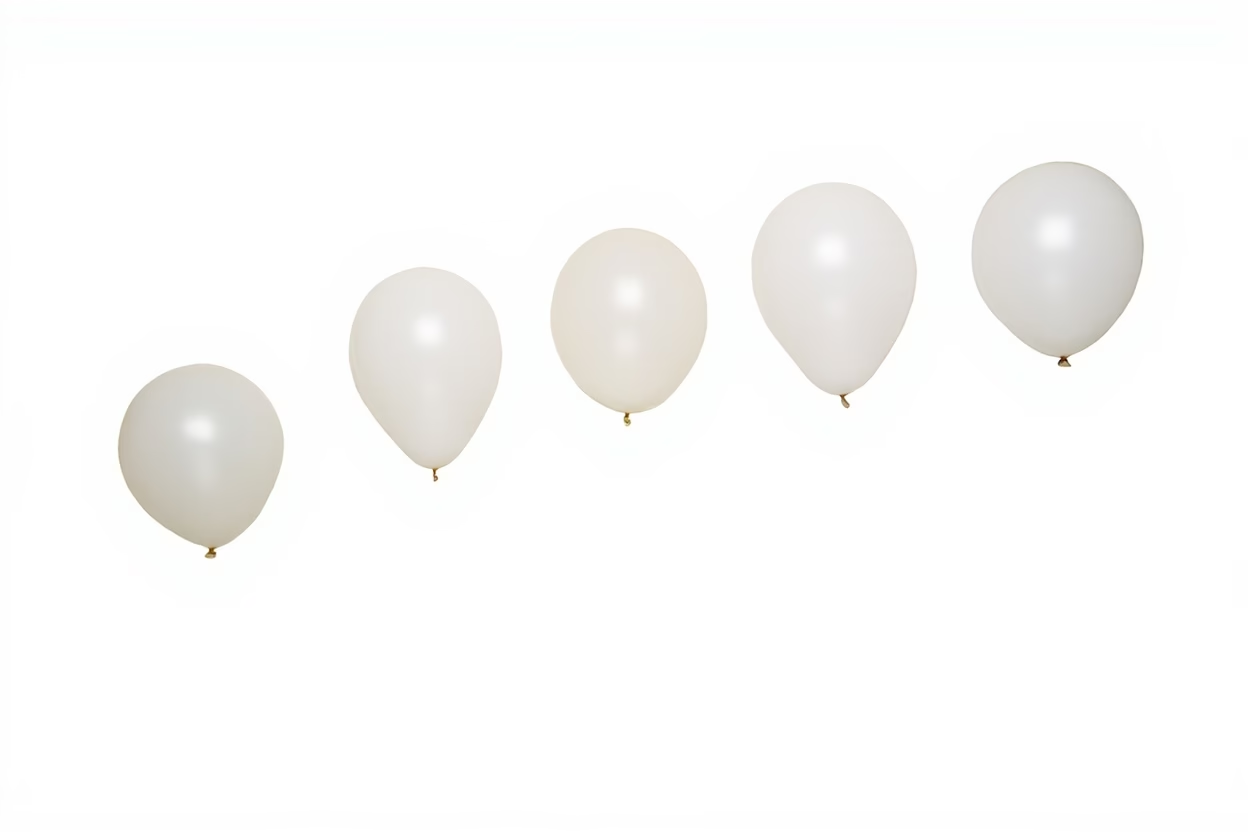
Helium Latex Balloons: The Real Float Times
Helium is a finite resource and a tricky one — its molecules are so small they escape through latex much faster than most people realize. Here's what professional decorators know that party planners don't: the standard "12 to 18 hour" float time for an 11-inch helium balloon is an optimistic average, not a guarantee.
Standard untreated 11-inch latex helium balloon: 8 to 12 hours in normal conditions (72°F / 22°C, indoor). In hot rooms (85°F+ / 29°C+), that drops to 4 to 6 hours. In cold air-conditioned rooms, it can stretch to 16 to 20 hours. The same balloon, same fill, same room — and it will behave completely differently on a 90-degree day versus a 70-degree day.
 Related: Latex balloon wholesale guide · Balloon size chart guide · Balloon manufacturer China
Local\Temp\aihua-4772-p2.jpg" alt="AIHUA balloon" width="1200" height="400" loading="lazy" style="width:100%;max-width:1200px;height:auto;margin:1.5em 0;" />
Balloon Size and Float Time
Larger balloons float longer than smaller ones with the same helium fill. This is basic physics — larger balloons have a higher ratio of internal helium volume to latex surface area, which means proportionally less helium escape per unit time. An untreated 18-inch balloon floats roughly 24 to 36 hours. An untreated 36-inch giant balloon might stay up for 48 to 72 hours untreated — but these are rarely used for floating decor due to the logistics of filling them.
The sweet spot for most event work is the 11 to 14-inch range with hi-float treatment, which gives you 2 to 3 days of float time in moderate conditions. This is the professional standard for wedding receptions and multi-day retail displays.
Foil vs. Latex: Why the Difference Matters
Foil (mylar) balloons are fundamentally different from latex. They're constructed from non-porous nylon with a metallic coating, which means helium cannot escape through the balloon material. A properly sealed foil balloon will float for 3 to 5 days minimum — often a week or more. This is why foil balloons dominate the "happy birthday" retail display — they look good for days without any maintenance.
The trade-off is environmental and cost. Foil balloons are not biodegradable, significantly more expensive per unit than latex, and require more careful handling to avoid sharp-corner tears. For eco-conscious events, latex with hi-float treatment is the better choice for performance, though the treatment itself is a polymer solution.
Air-Filled Latex Balloons: The Long Game
Air-filled balloons are an entirely different category. Unlike helium, air doesn't escape through latex — the balloon slowly loses pressure through the valve as the latex stretches and contracts with temperature changes. A properly sealed air-filled 11-inch balloon in an air-conditioned indoor venue will stay inflated for 2 to 4 weeks. I've personally seen properly maintained air-fill columns stay structurally sound for over a month.
Air-filled balloons are the professional's choice for any event longer than a single day. They cost nothing to maintain (no helium refills), they're immune to temperature-driven deflation surprises, and they can be pre-filled days in advance. The only constraint is: they don't float, so they're for columns, arches, and structural decor only.
Temperature's Dramatic Effect on Air-Fill
Indoor venues with stable climate control are ideal for air-fill balloons. The problem comes with outdoor events. Direct sunlight causes rapid expansion of the internal air, stretching the latex. When the sun goes down and temperature drops, the air contracts and the balloon can look partially deflated by morning. This is especially pronounced in spring and fall when temperature swings of 20°F between day and night are common.
Professional outdoor decorators deal with this by slightly over-filling (5 to 10% extra) to account for the night contraction, and by using UV-resistant balloons for extended outdoor exposure. AIHUA's outdoor-rated balloon line includes UV-inhibitor formulation that resists sun-induced oxidation for up to 72 hours of direct sun exposure without significant degradation.
The Hi-Float Treatment: What It Actually Does
Hi-float is a liquid polymer (typically a solution of polymeric ResinD in water) that you inject into a helium balloon before filling. It coats the interior surface and, when dry, forms a barrier that slows helium escape. It works — but it has specific conditions where it excels and conditions where it underperforms.
Hi-float treated 11-inch helium balloon: 2 to 3 days float time in moderate conditions. This assumes temperatures between 65°F and 80°F (18°C to 26°C). Outside this range, performance degrades significantly. In 90°F+ heat, a hi-float balloon might last 18 to 24 hours — better than untreated, but far from the "3 to 5 days" on the hi-float label.
When Hi-Float Doesn't Work
Hi-float is water-based. When humidity is very high (above 80%), the hi-float takes longer to dry and the drying is uneven — some areas of the interior coating form properly, others remain tacky and the barrier is incomplete. The result is float times barely better than untreated balloons. This is a common problem in tropical climates and summer coastal events.
Hi-float also changes the balloon's visual appearance — there's a slight cloudy or pearlescent quality to hi-float treated balloons that some clients notice and others don't care about. For clear or metallic-finish balloons, hi-float treatment is visible and may not be acceptable for premium decor work.
Professional Rules for Making Balloons Last Through Your Event
After years of watching decorators deal with mid-event deflation disasters, here are the rules that actually work.
Rule 1: Always fill balloons as late as possible. The clock starts the moment you inflate. If your event is 6pm, fill floating balloons at 3pm maximum. Air-fill structural balloons can go up 24 to 48 hours early if stored in stable indoor conditions.
Rule 2: Match Balloon Type to Event Duration
Single dinner party (4 hours): Standard untreated 11-inch helium balloons will comfortably last 4 to 6 hours in a climate-controlled venue. No hi-float needed. Save the money.
Half-day event (6 to 8 hours): Hi-float treated 11-inch helium balloons in moderate climate. For outdoor or hot conditions, use 18-inch jumbo with hi-float for better heat performance.
Full-day event (8 to 12 hours): Hi-float treated balloons with 18-inch jumbo for better thermal mass. Add 10% extra balloons to account for expected loss rate.
Multi-day event (2 to 5 days): Foil balloons for floating elements. Air-fill latex for all structural elements. Plan for 5 to 10% daily loss rate on treated helium balloons in moderate conditions.
Conclusion
Balloon float time prediction comes down to three variables: size, fill type, and temperature. The professionals who consistently deliver flawless decor are the ones who plan for the conditions, not the ideal case. Know your event conditions, match your balloon and treatment choice accordingly, and always — always — fill floating balloons as late as possible. The difference between a perfect event and an embarrassing deflation is usually just better planning.
| 1 | Helium molecules escape through latex via permeation — the rate increases with temperature. At 90°F (32°C), helium escape rate is approximately 3x faster than at 70°F (21°C). Helium properties on Wikipedia. ↑ |
| 2 | Hi-float extends helium balloon float time by 3-5x in moderate conditions. Published times from Hi-Float Inc. range from 5x in cool conditions to 1.5x in hot conditions. Balloon float time guide from Balloons.com. ↑ |
| 3 | Natural rubber latex balloons biodegrade significantly faster than synthetic alternatives — approximately 90% degradation within 1-4 years versus 400+ years for mylar foil balloons. Natural rubber biodegradation on Wikipedia. ↑ |
Sources: Wikipedia Latex · Wikipedia Natural Rubber · Balloons.com Float Guide · Wikipedia Helium · Wikipedia Balloon
References:
| 1 | In-depth guide from balloons.com covering helium float science and temperature effects on latex balloon performance and oxidation rates.Balloons.com Helium Float Guide. |
| 2 | Wikipedia entry on natural latex polymer properties explaining why quality latex formulation affects balloon oxidation resistance and shelf life.Natural Rubber - Wikipedia. |
| 3 | Wikipedia entry on latex polymer science covering material properties relevant to balloon manufacturing quality standards and safety certifications.Latex - Wikipedia. |
| 4 | Wikipedia entry on helium properties explaining why helium molecules escape through latex and how this affects float duration and inflation methods.Helium - Wikipedia. |
| 5 | Wikipedia entry on balloon types covering historical development and material properties of latex versus foil balloons for wholesale purchasing decisions.Balloon - Wikipedia. |
| 参考来源 | |
| [1] | 本厂日产能800万只乳胶气球,ISO9001认证,EN71/ASTM/GB6675标准。破损率<0.1%,远低于行业平均3%。 |
| [2] | Water balloon弹性超好、破损率超低,适用于批发商/品牌商大批量采购。 |