
How Much Weight Can a Standard 11-Inch Helium Balloon Actually Lift?
Planning an event and underestimating balloon lift1? This common mistake can deflate your decorations and your budget. Let’s get the facts straight to ensure your plans take flight perfectly.
A standard 11-inch helium balloon can lift about 12 to 14 grams (or around 0.5 ounces). This accounts for the weight of the balloon and string, leaving a small net lift2 perfect for a ribbon or a very light party favor.

This simple answer is a great starting point, but as a procurement manager, you know the details matter. Factors like air temperature3, altitude4, and even the quality of the latex itself can change this number. To ensure your large-scale events or promotions are successful, you need to understand the variables that can affect performance. Let's dive deeper into what really influences a balloon's lifting power and how you can calculate what you need for any project.
What factors, like altitude and temperature, affect a balloon's lift capacity?
You've calculated your lift based on standard numbers. But what if your event is on a hot day or at a high-altitude location? These environmental factors5 can alter performance unexpectedly.
Altitude and temperature directly impact a balloon's lift. Higher altitudes reduce lift because the surrounding air is less dense. Conversely, higher temperatures can slightly increase lift as the helium inside the balloon expands, increasing its volume and buoyancy.

The science behind a balloon's lift is all about density. A balloon floats because the helium inside it is much less dense than the air outside it. This difference creates a buoyant force6 that pushes the balloon upward. However, the density of the air around us isn't constant. It changes with the weather and your location, and those changes directly impact your balloon's performance. As someone who has managed supply chains for decades, I've seen how these small details can have a big impact on a product launch or event.
Altitude
As you go higher above sea level, the air pressure drops, and the air becomes thinner, or less dense. This reduces the density difference between the helium in the balloon and the outside air. The result is less buoyant force. A balloon that lifts 14 grams at sea level in Los Angeles will lift noticeably less in a city like Denver, which is a mile high. For major promotions, this difference is critical to account for.
Temperature
Temperature has a more complex effect. When you heat a gas, it expands. On a hot day, the helium inside your balloon will expand, increasing the balloon's volume and, therefore, its buoyant force. However, the surrounding air is also hotter and less dense, which can counteract some of that gain. Generally, a warmer temperature gives a slight boost to lift, while a very cold day will cause the helium to contract, reducing the balloon's volume and lift.
| Factor | Effect on Air Density | Impact on Balloon Lift |
|---|---|---|
| Higher Altitude | Decreases | Decreases |
| Lower Altitude | Increases | Increases |
| Higher Temp | Decreases | Slightly Increases |
| Lower Temp | Increases | Slightly Decreases |
How does balloon material, such as latex quality, influence its lifting power?
You might think all latex balloons are the same. But choosing a lower-quality option to save costs can backfire, resulting in poor performance and a shorter float time7 for your display.
The quality of the latex is vital for lifting power. Premium latex is lighter and less porous. This means it has a better lift-to-weight ratio from the start and loses helium much slower, maintaining its lift for a longer period.

At AIHUA BALLOON, we've spent over 37 years perfecting our manufacturing processes because we know that not all latex is created equal. The final lift capacity8 of a balloon isn't just about the helium inside; it's a balance between the upward buoyant force and the downward pull of the balloon's own weight. This is where material science becomes essential for a reliable product. For a procurement manager like you, understanding this is key to sourcing products that won't fail.
Balloon Weight
The total available lift, or "net lift," is the total buoyant force of the helium minus the weight of the balloon itself. A standard 11-inch latex balloon weighs around 3 grams. If a cheaper balloon is made with heavier, lower-grade latex, it could weigh more. This extra weight directly subtracts from its lifting ability, leaving you with less net lift for ribbons, lights, or anything else you want to attach.
Helium Retention
Latex is a natural material with microscopic pores. High-quality manufacturing processes create a stronger, more uniform, and less porous material. This is crucial for helium retention9. A balloon made from high-grade latex will hold its helium for much longer, meaning it will float higher and maintain its lift capacity8 for the entire duration of your event. Low-quality balloons often leak helium faster, causing them to droop and lose lift within hours.
| Latex Quality | Balloon Weight | Helium Retention | Net Lift Performance |
|---|---|---|---|
| High-Quality | Lighter | Excellent | Stronger initial lift, floats longer |
| Low-Quality | Heavier | Poor | Weaker initial lift, droops quickly |
How can you calculate the total lift for a large number of balloons for an event or promotion?
You're planning a big balloon release or trying to lift a banner. Just guessing how many balloons you need is a risky strategy that could lead to failure or wasted inventory.
To calculate the number of balloons needed, first weigh the object you want to lift in grams. Then, divide that total weight by the net lift of a single balloon (use a conservative estimate, like 12 grams for an 11-inch balloon).

Doing this calculation is a fundamental step in planning any large-scale project involving balloons. As someone responsible for procurement, you need reliable figures to ensure you order the correct quantity and that the final display performs as expected. Getting it right prevents last-minute panic and ensures a successful outcome. I've helped clients with these calculations for years, and a simple, structured approach is always the best way to go.
Step 1: Determine the Total Weight
First, you need the precise weight of the object you intend to lift. Use a digital scale to weigh everything, including any strings, banners, lights, or attachments. Let's say you want to lift a small promotional sign that weighs 1 kilogram. Remember to convert this to grams, since balloon lift is measured in grams.
- 1 kilogram = 1000 grams
Step 2: Use a Conservative Net Lift Value
While an 11-inch balloon can lift up to 14 grams, it's always safer to use a more conservative number for your calculations. This builds in a margin of error to account for variations in inflation, temperature, or balloon quality. I recommend using 12 grams as the average net lift per balloon.
Step 3: Calculate the Number of Balloons
Now, you can perform the final calculation. Simply divide the total weight of your object by the net lift of a single balloon.
- Formula: Total Weight (g) / Net Lift per Balloon (g) = Number of Balloons Needed
- Example Calculation: 1000 g / 12 g per balloon = 83.33 balloons
Since you can't use a fraction of a balloon, you should always round up to the next whole number. To be extra safe, I always advise adding a small buffer of 5-10% more balloons.
| Object Weight | Calculation | Balloons Needed (Rounded Up) | Recommended with Buffer (10%) |
|---|---|---|---|
| 500 g | 500 / 12 | 42 | 46 |
| 1000 g (1 kg) | 1000 / 12 | 84 | 92 |
| 2000 g (2 kg) | 2000 / 12 | 167 | 184 |
Where can businesses source high-quality helium balloons with reliable lift specifications?
You need a large volume of balloons that perform consistently. Sourcing from unverified suppliers risks receiving low-quality products that fail, damaging your event's success and your company's reputation.
For reliable, high-quality helium balloons, partner with an established manufacturer that holds international certifications10 like Sedex and ISO9001. A reputable supplier will provide detailed product specifications, including consistent weight and performance data.
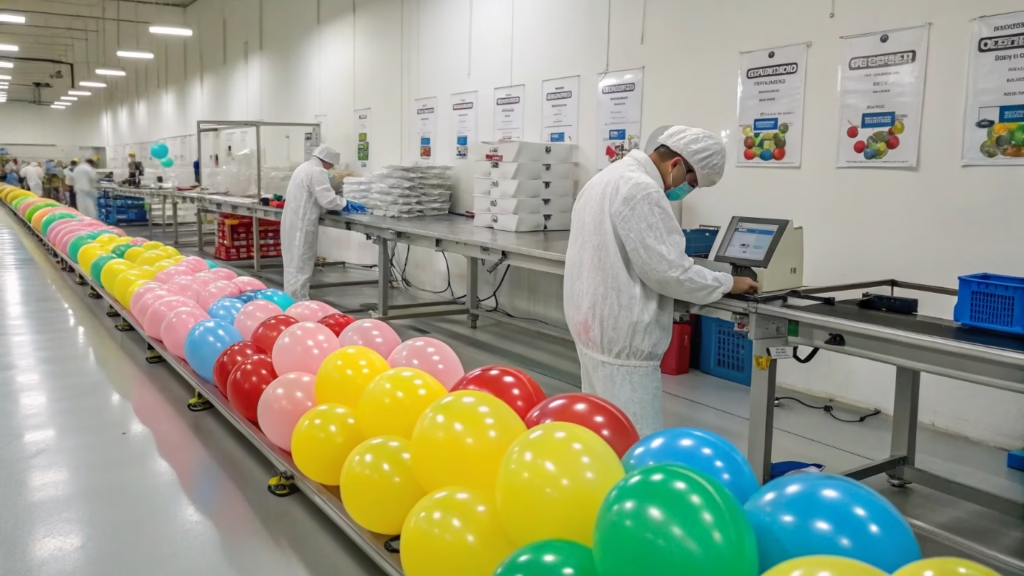
As a procurement manager, your top priorities are quality, safety, and supply chain reliability11. Finding a partner who understands these needs is non-negotiable. At AIHUA BALLOON, we have built our business over 37 years by focusing on exactly that. Our commitment to excellence is why we've become a trusted supplier for major international retailers. We provide the documentation and consistent quality you need to execute your projects with confidence.
Look for Certifications and Experience
A manufacturer's certifications are a clear indicator of their commitment to quality and ethical practices.
- ISO 9001: This certification ensures the supplier has a robust quality management system in place. It means they have standardized processes for production, testing, and continuous improvement, leading to a more consistent and reliable product.
- Sedex/BSCI: These certifications demonstrate a commitment to ethical and responsible sourcing. They ensure that the manufacturer adheres to fair labor practices and social compliance standards, which is increasingly important for global brand reputation.
- 37+ Years of Experience: In this industry, longevity speaks volumes. A company with decades of experience, like ours, has refined its processes and built a deep understanding of material science and customer needs.
Demand Detailed Product Specifications
A professional supplier should be able to provide you with a comprehensive technical data sheet for their products. This should include:
- Average Balloon Weight: To help you accurately calculate net lift.
- Material Composition: To ensure it meets safety standards like EN71.
- Recommended Inflation Size: To guarantee optimal performance and float time.
When you partner with us at AIHUA BALLOON, you get more than just a product. You get a reliable partner dedicated to your success, providing fully compliant, high-performance balloons backed by decades of expertise.
Conclusion
Understanding balloon lift involves more than one simple number. By considering environmental factors, material quality, and proper calculation, you can ensure your large-scale balloon projects are always successful and impressive.
-
Understanding balloon lift is crucial for successful event planning and decoration. ↩
-
Learn about net lift to ensure your decorations stay afloat during events. ↩
-
Understanding temperature effects can help you plan better for outdoor events. ↩
-
Learn how altitude changes balloon performance to avoid event mishaps. ↩
-
Understanding environmental factors can help you plan better for outdoor events. ↩
-
Understanding buoyant force is key to successful balloon decoration. ↩
-
Explore factors that influence float time to ensure your balloons last longer. ↩
-
Knowing lift capacity helps in planning the right number of balloons for events. ↩ ↩
-
Explore helium retention to ensure your balloons last throughout the event. ↩
-
Learn about important certifications to ensure quality and safety in balloon sourcing. ↩
-
Learn about maintaining supply chain reliability for consistent balloon quality. ↩