
What makes a latex balloon biodegradable quality?
Are you confused by "biodegradable1" claims? It's a common term, but what it means for latex balloons can be unclear, making responsible sourcing2 difficult.
A latex balloon's biodegradable quality comes from its main ingredient: natural rubber latex3. This is sap from rubber trees. Microorganisms can break it down. But, chemicals used in manufacturing and the final environment, like a landfill, can significantly slow this process down.
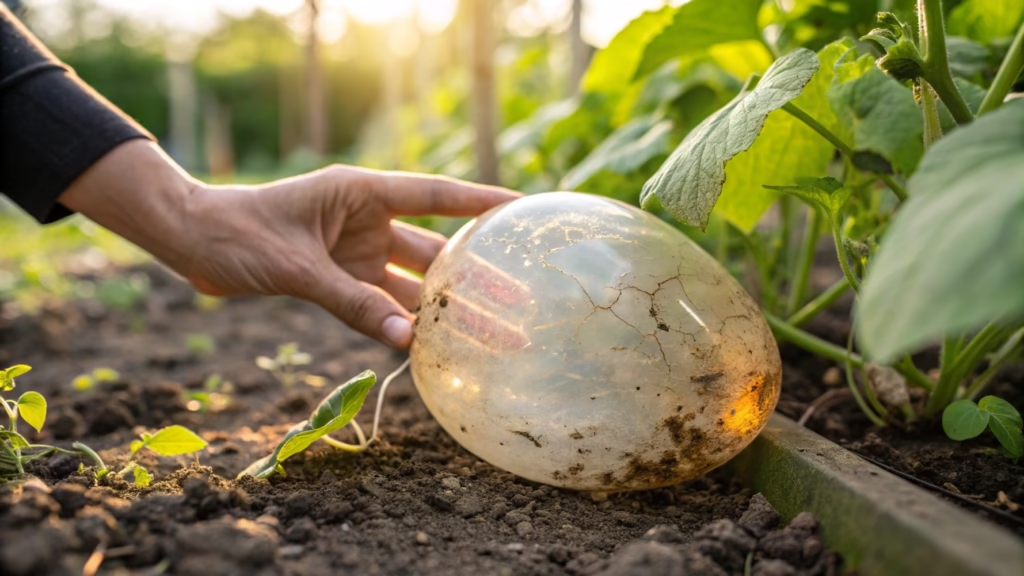
As a procurement manager, you need to look beyond the simple marketing claims. Your brand's reputation and environmental commitments4 depend on understanding the real story behind a product's lifecycle. Digging into the details of raw materials, certifications, and decomposition facts is not just good practice; it’s essential for making informed purchasing decisions. Let's break down what truly makes a balloon biodegradable and what you should be asking your suppliers.
How can you verify the purity of the natural latex used?
You're told a balloon is "natural latex," but you worry about impurities. Unverified materials could compromise quality and eco-claims. Here's how to get the proof you need.
To verify latex purity, you should request key documents. Ask for the Material Safety Data Sheet (MSDS)5 and supplier Declarations of Conformity. For the highest level of assurance, demand third-party lab test reports6 that analyze the material's exact chemical composition.
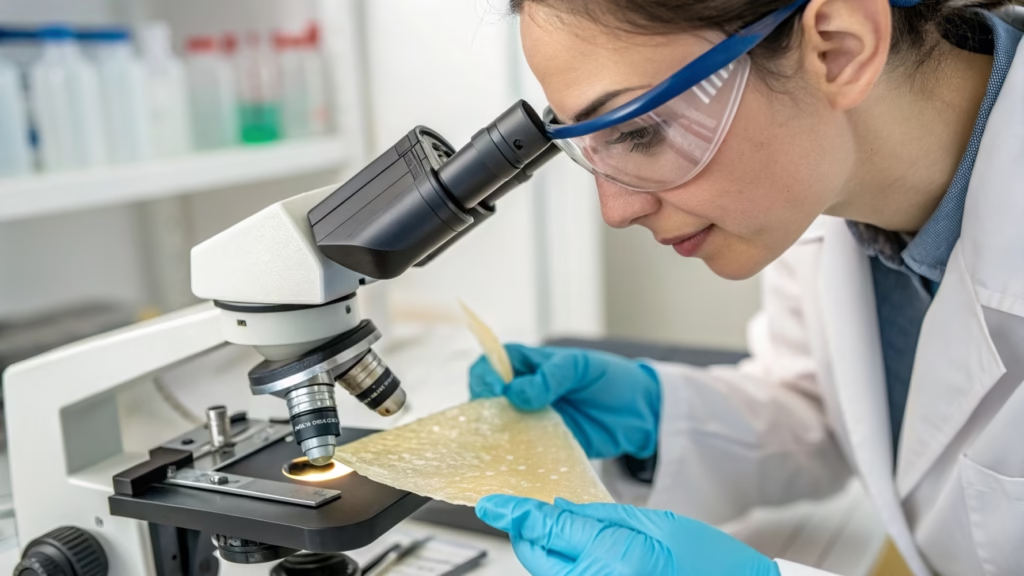
In my experience working with major retailers, documentation is the first step, but it's not the whole story. We need to go deeper to ensure what's on paper matches the actual product. A supplier who is confident in their product will have no problem providing this information.
Step 1: Request Essential Documents
The first line of defense is paperwork. The Material Safety Data Sheet (MSDS), now often called a Safety Data Sheet (SDS), lists the components and potential hazards. A Declaration of Conformity7 is a supplier's formal statement that their product meets certain standards. These documents provide a baseline of transparency. We always provide these to our partners because it builds a foundation of trust. However, a truly diligent procurement manager knows to look for more concrete proof.
Step 2: Insist on Third-Party Lab Testing
This is where you separate the good suppliers from the great ones. Independent lab tests provide unbiased proof of a material's composition. A common method is Fourier-transform infrared spectroscopy (FTIR)8, which creates a chemical "fingerprint" of the latex. It can accurately identify the percentage of natural rubber versus synthetic fillers or other unwanted additives. When a partner requests this, I see it as a sign of their commitment to quality, a value we share.
| Verification Method | Reliability | Cost to Buyer | Time Required |
|---|---|---|---|
| Supplier Document Review | Medium | Low | Fast |
| Third-Party Lab Testing | High | Medium-High | Slow |
| Factory Audit & Inspection | High | High | Slow |
What international standards or certifications validate biodegradability claims?
The word "biodegradable" alone means very little. Without a standard, the claim is weak and risky for your brand. You need certifications to back it up.
Key international standards that validate biodegradability are ASTM D53389 and ISO 1485510. These define how to test for aerobic biodegradation under controlled composting conditions. A product certified to these standards has proven it can break down effectively in a commercial compost facility11.
It is important to understand what these certifications actually mean for a balloon. They test for breakdown in a very specific, ideal environment—a commercial composting facility. The reality is that very few balloon manufacturers hold these specific certifications because the end-of-life scenario for a balloon is rarely a compost pile. Still, knowing these standards exist helps you ask suppliers tougher questions about their own testing and data. It shows you've done your homework.
The Gold Standard: ASTM D5338
ASTM D5338 is a standard test method from the United States. It specifies the procedure for determining the degree and rate of aerobic biodegradation of plastic materials in a controlled composting environment. Essentially, the material is mixed with compost and its conversion to carbon dioxide is measured over time. A high conversion rate indicates good biodegradability. It’s a rigorous test and provides strong scientific evidence, but again, it reflects a best-case scenario.
The Global Equivalent: ISO 14855
ISO 14855 is the international counterpart to the ASTM standard. It works in a very similar way, measuring the ultimate aerobic biodegradability of a material under controlled composting conditions. For companies operating globally, like my clients in Europe and North America, referencing an ISO standard is often preferred. Both standards provide a framework, and a supplier that can provide test data based on these methods—even if not formally certified—is showing a higher level of commitment.
| Standard | Region | Test Environment | Key Measurement |
|---|---|---|---|
| ASTM D5338 | Primarily USA | Controlled Composting | Carbon Dioxide Evolution |
| ISO 14855 | International | Controlled Composting | Carbon Dioxide Evolution |
| EN 13432 | Europe | Industrial Composting | Disintegration & Ecotoxicity |
What is the expected decomposition timeline in different environments?
A balloon's decomposition time isn't a fixed number. You might worry that it lasts forever in some places, creating waste. Understanding the timeline in different environments is key.
A latex balloon can decompose in a few months to a few years in a biologically active environment12 with abundant microbes, sunlight, and moisture. But in a landfill without oxygen, decomposition slows dramatically and can take decades, similar to an oak leaf.
[^13]s in different environments like soil, water, and landfill](https://aihuaballoon.com/wp-content/uploads/2025/10/an-infographic-style-diagram-illustrating-the-dec-1024x576.avif)
The claim that a latex balloon biodegrades "at the same rate as an oak leaf" is often used in our industry. While true in principle, it's a statement I use with caution. An oak leaf on a forest floor is very different from one buried deep in a landfill. The same is true for a balloon. As a responsible manufacturer, I believe it's my duty to explain this context to partners like you, so you can communicate it accurately to your customers.
Best Case: Active Soil or Compost
In an environment rich with microorganisms, moisture, and oxygen, like a garden or a commercial compost facility11, the process is relatively fast. Microbes secrete enzymes that break down the polymer chains of the natural rubber. UV light from the sun also helps to initiate this breakdown. In these ideal conditions, you could see a balloon break down into small fragments within six months and largely disappear within a couple of years.
Worst Case: The Modern Landfill
A landfill is the opposite of an ideal environment. Waste is tightly compacted, cutting off oxygen and light. This creates an anaerobic (oxygen-free) environment. The microbes that thrive here work much more slowly. In this setting, a latex balloon will persist for a very long time, potentially decades or longer. It breaks down, but at a rate so slow that it contributes to landfill mass for generations. This is the hard reality we must face.
| Environment | Oxygen Level | UV Light Exposure | Microbial Activity | Expected Timeline |
|---|---|---|---|---|
| Commercial Compost | High | Low to Medium | High | 6 months - 2 years |
| Backyard Soil | Medium | High | Medium | 1 - 3 years |
| Marine Environment | High | High | Variable | 1 - 5 years |
| Landfill | Very Low | None | Low (Anaerobic) | 50+ years |
Do the dyes and inks used affect the balloon's ability to biodegrade?
You know pure latex is biodegradable, but what about the colors? You worry that the vibrant dyes and printed logos could introduce toxins and stop the natural process.
Yes, the dyes and inks13 have a major impact. Heavy-metal-based pigments and petroleum-based inks can harm microbes, which slows down decomposition. They may also release toxins into the environment. Using organic dyes14 and water-based inks15 is critical for preserving biodegradability.
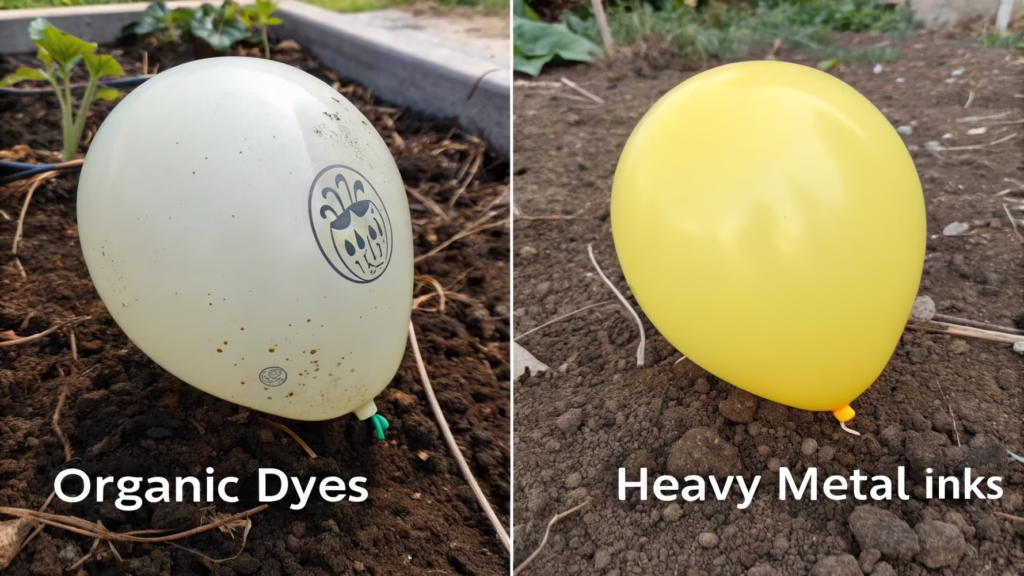
This is an area where we, as manufacturers, have a huge responsibility. It's easy to cut costs by using cheaper, chemical-heavy pigments. But for buyers at companies like GlobalMart, who are focused on safety and compliance, the choice of dyes is a non-negotiable point of quality control. When I discuss our production process, I always emphasize our commitment to using non-toxic, eco-friendly colorants precisely because I know how important it is for your brand standards.
The Problem with Traditional Colorants
Many low-cost pigments used in the past contained heavy metals like lead, chromium, and cadmium. These elements are toxic to the soil and to the microorganisms that are essential for decomposition. If the microbes are poisoned, the breakdown process grinds to a halt. Similarly, many printing inks are solvent-based, using petroleum distillates that are not readily biodegradable and can contaminate groundwater. For this reason, checking a supplier's compliance with regulations like REACH in Europe is a crucial step.
The Solution: Eco-Friendly Alternatives
The best practice today is to use organic pigments and water-based inks. Organic pigments are derived from carbon-based molecules and do not contain heavy metals. Water-based inks use water as the main solvent instead of petroleum chemicals. These alternatives are designed to be non-toxic and break down more easily along with the natural latex. They might cost slightly more, but the investment ensures a safer, more compliant, and truly more biodegradable product.
| Component | Impact on Biodegradation | Environmental Risk | Relative Cost |
|---|---|---|---|
| Heavy Metal Pigments | Negative - Can inhibit microbial activity16 | High (Toxic) | Low |
| Solvent-Based Inks | Negative - Slows process, non-biodegradable components | High (Pollutant) | Medium |
| Organic Pigments | Neutral - Does not hinder the process | Low | High |
| Water-Based Inks | Neutral - Breaks down with the latex | Low | Medium-High |
Conclusion
True biodegradable quality in a latex balloon depends on pure latex, safe additives, and the right disposal environment. Asking the right questions is key to responsible sourcing2.
-
Understanding the true meaning of biodegradable can help you make informed purchasing decisions. ↩
-
Understand the importance of ethical sourcing in product selection. ↩ ↩
-
Explore the advantages of natural rubber latex for eco-friendly products. ↩
-
Find out how transparency and certifications can enhance brand reputation. ↩
-
Learn how MSDS documents ensure safety and compliance in product sourcing. ↩
-
Find out how independent testing can validate product claims and quality. ↩
-
Discover how this document guarantees product standards and safety. ↩
-
Understand how FTIR testing provides insights into material composition. ↩
-
Learn about this standard and how it validates biodegradability claims. ↩
-
Explore the international standards for testing biodegradability in products. ↩
-
Learn how these facilities support effective biodegradation processes. ↩ ↩
-
Learn about the ideal conditions for effective biodegradation. ↩
-
Find out how colorants can impact the environmental safety of products. ↩
-
Explore how organic dyes contribute to safer and more sustainable products. ↩
-
Learn about the advantages of using eco-friendly inks in manufacturing. ↩
-
Explore the role of microbes in breaking down materials effectively. ↩