What’s the difference between FSC and EUDR?
Struggling with new EU rules? You worry your products might get blocked at the border. You need to understand the new landscape, but the information is complex and confusing.
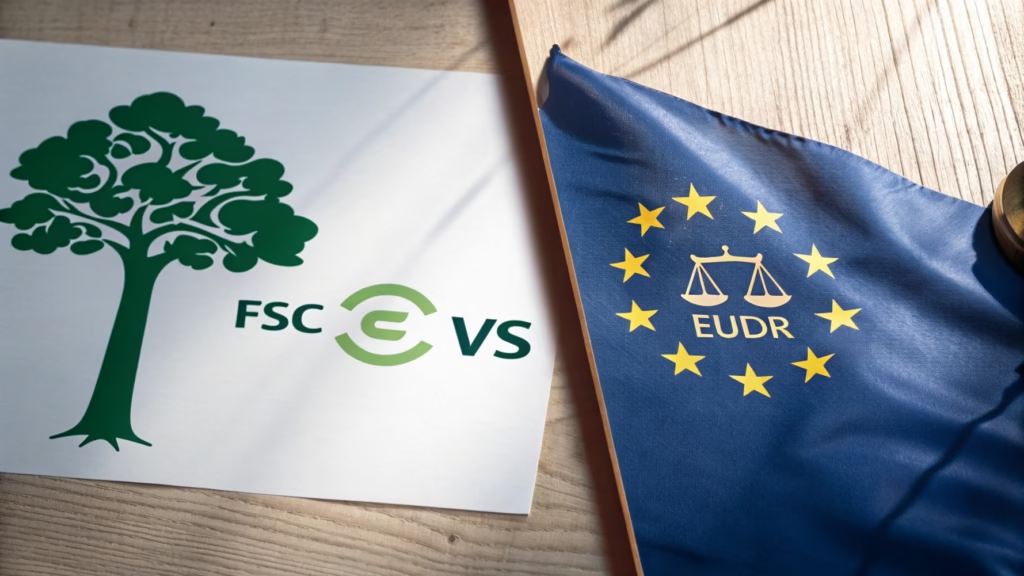
Fundamentally, the EUDR is a mandatory law for accessing the EU market1, while FSC is a voluntary certification showing responsible sourcing2. The EUDR requires specific due diligence, including geolocation data3, which FSC certification alone does not automatically provide. They are complementary, not interchangeable.
As the person responsible for our global partnerships at AIHUA BALLOON, I've spent countless hours with procurement managers just like you. We've been deep in conversation about the new European Union Deforestation-Free Regulation (EUDR). Many of my partners, who have always relied on certifications like the Forest Stewardship Council (FSC), are now asking how this all fits together. The confusion is understandable. These changes are significant, and the stakes are high for your supply chain. Let's break down these topics piece by piece so you can move forward with total confidence.
Is FSC a mandatory regulation or a voluntary certification?
Are you feeling pressured to get every certification? It's hard to know which ones are nice to have and which ones are absolutely necessary. The lines can feel blurry.
FSC is a voluntary certification. Companies choose to get FSC certified to show customers their commitment to responsible forest management. It is not a government law. In contrast, regulations like the EUDR are mandatory legal requirements for market access.
In my decade of experience, I've seen certifications act as powerful tools for building trust4. When we at AIHUA BALLOON pursued our certifications, it was to signal our commitment to quality and ethical Practices to partners like you. FSC works in the same way. It's a market-driven initiative. Think of it as earning a badge of honor that tells your customers you care about where your materials come from. It helps you stand out. A government regulation, however, is not optional. It’s a rule of entry, like having a passport to enter a country. The EUDR is exactly that—a legal gateway for the EU market.
To make this clearer, let's look at the core differences.
The Purpose of Each System
- FSC (Voluntary Certification): Its main goal is to promote responsible management of the world’s forests. It gives consumers a choice to support businesses that follow strict environmental and social standards. It is a proactive choice made by a company.
- EUDR (Mandatory Regulation): Its goal is to stop deforestation caused by products sold in the EU. It is a legal requirement imposed by a government body, the EU, on any company wanting to sell relevant products there.
Here is a simple table to compare them.
| Feature | FSC (Forest Stewardship Council) | EUDR (EU Deforestation-Free Regulation) |
|---|---|---|
| Type | Voluntary Certification | Mandatory Legal Regulation |
| Primary Goal | Promote responsible forest management | Prevent deforestation in supply chains |
| Who Enforces It? | Independent, non-governmental auditors | EU Member State authorities |
| Consequence | Market advantage, brand reputation | Legal access to the EU market |
| Non-Compliance | Cannot use the FSC label | Fines, confiscation of goods, market ban |
So, while both aim to protect forests, one is a choice for market positioning, and the other is a strict rule for market access.
Does having an FSC certification guarantee EUDR compliance?
You've invested time and money into getting FSC certification for your supply chain. Now, you’re wondering if all that hard work will automatically satisfy the new EUDR rules.
No, having an FSC certification does not automatically guarantee EUDR compliance5. The EUDR has specific legal requirements, like providing precise geolocation data6 for the plot of land, which are not always covered by standard FSC chain of custody audits.
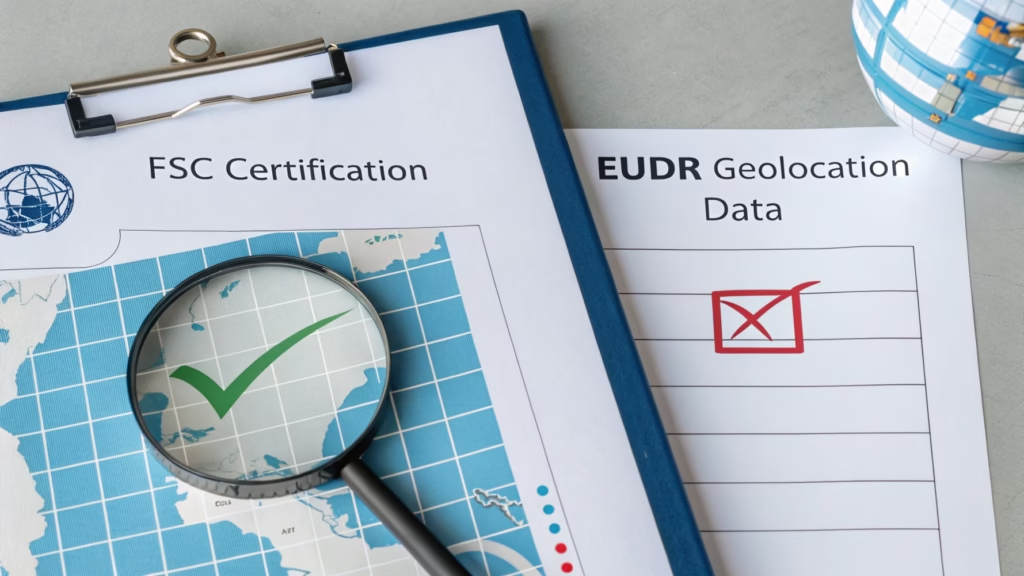
This is the most common misunderstanding I encounter, and it's a dangerous one. A few months ago, a partner believed their existing FSC-certified supplier was all they needed. They were shocked when I explained the specific data points the EUDR demands. Relying on FSC alone creates a major compliance gap. Think of FSC as a strong foundation. It proves a commitment to responsible sourcing and often means a supplier's traceability systems are better than average. It is a great starting point and can make EUDR compliance easier. But it is not the final step.
Let's dive deeper into why this is the case.
Key Gaps Between FSC and EUDR
The EUDR introduces a specific legal obligation on the "operator" (the company first placing the goods on the EU market) to conduct due diligence. This goes beyond what FSC certification audits typically require.
- Geolocation Data: The EUDR requires precise geolocation coordinates for the specific plots of land7 where the raw material was produced. While FSC promotes traceability, it does not always mandate collecting and passing along this exact GPS data through the entire supply chain to the final importer. This is a new, non-negotiable data requirement.
- Due Diligence Statement (DDS)8: For every shipment, the importer must submit a formal DDS to the EU authorities. This is a legal declaration confirming that due diligence has been performed and that the products are deforestation-free and comply with local laws of the production country. FSC provides a certificate, not a shipment-by-shipment legal statement.
- Legal Responsibility: Under the EUDR, the legal liability rests squarely on the importer in the EU9. A certification body does not take on this legal risk. Thinking an EUDR check is just another audit is a mistake. An audit identifies non-conformance. An EUDR check by authorities can lead to legal penalties.
Therefore, you cannot assume your FSC-certified supplier has automatically made you EUDR compliant. You must actively work with them to close these gaps.
What due diligence is required for importers under the EUDR?
The term "due diligence" sounds complicated and official. You may be worried about what it actually means in practice and if simply trusting your supplier's word is enough.
Under the EUDR, due diligence is a mandatory three-step process10. You must collect detailed information, perform a risk assessment, and implement mitigation measures11 if any risk is found. A simple promise from a supplier is not sufficient legal proof.
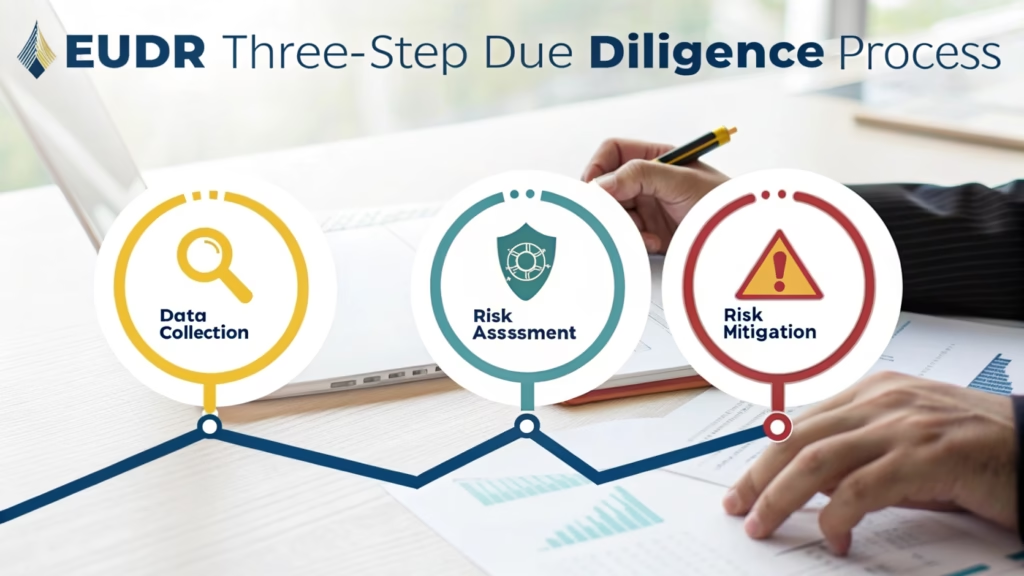
I often tell my partners that the era of "trust but don't verify" is over with the EUDR. The regulation puts the legal burden on the importer to prove their products are clean. A supplier's promise or even a general certificate is not the proof. You need a documented process12. At AIHUA BALLOON, we are already working to provide our partners with the detailed information they need for their due diligence systems. The key is to see this not as a single action, but as an ongoing process that is integrated into your procurement workflow.
Let's break down the three mandatory steps of the due diligence process.
Step 1: Information Collection
You must gather comprehensive information about your product and supply chain. This is not optional.
- Product Description: Detailed description, including the product's scientific name (for timber) and quantity.
- Country of Production: The country where the raw material was grown or harvested.
- Geolocation: The precise coordinates of all plots of land where the commodity was produced. This is crucial. For plots over 4 hectares, you need the polygon (the boundary lines).
- Supplier Information: Contact details for your direct and indirect suppliers.
- Compliance Evidence: Verifiable information that the product is deforestation-free and was produced in accordance with the relevant laws of the production country.
Step 2: Risk Assessment
With the information collected, you must analyze the risk of non-compliance.
- Country-Level Risk: Does the country of origin have a high risk of deforestation or weak governance? The EU will provide a country benchmarking system13 for this.
- Supplier-Specific Risk: Is your supplier's supply chain complex or non-transparent? Have they been associated with deforestation in the past?
- Certification Value: The presence of a certification like FSC can be considered here as a factor that may lower the risk, but it does not eliminate it.
Step 3: Risk Mitigation
If your assessment shows anything other than a "negligible" risk, you must take steps to reduce that risk.
- Request More Data: Ask your supplier for more detailed information or third-party verification.
- Conduct Independent Audits: You may need to perform your own audits of the supply chain.
- Change Suppliers: In a high-risk situation where risk cannot be mitigated, the only option is to stop sourcing from that supply chain.
This systematic process is your legal defense. It shows you have acted responsibly.
For market access to the EU, which is more critical for my supply chain?
Deadlines are approaching, and resources are limited. You need to focus on what matters most to ensure your products can legally enter the European Union without any issues.
For EU market access, EUDR compliance is unquestionably more critical14. The EUDR is a legal requirement for entry; non-compliance means your products can be seized. FSC is a valuable market tool, but it will not grant you legal access on its own.
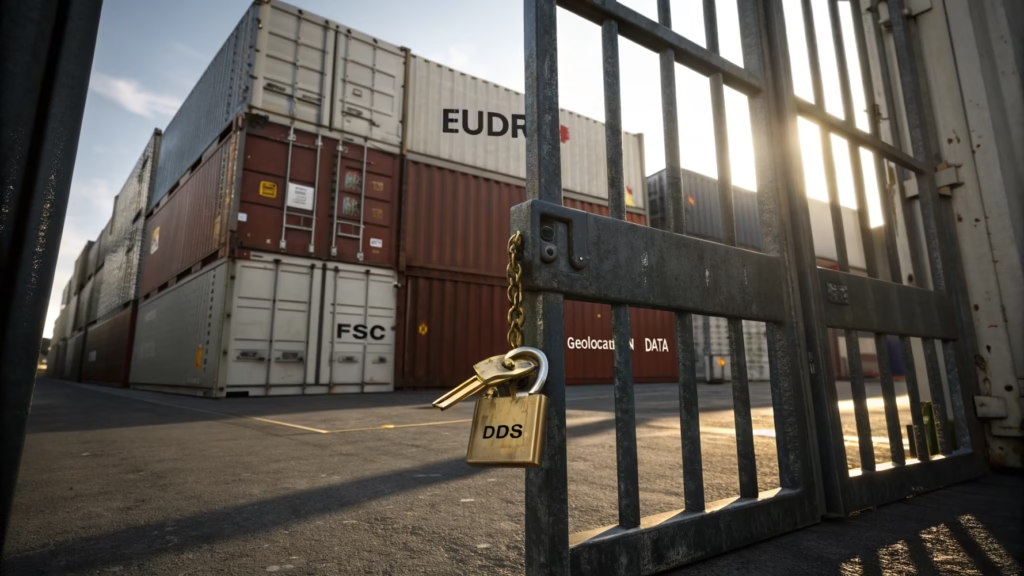
This is where we must be very direct. When I advise my partners on preparing their supply chains, I put it like this: the EUDR is the gate, and the Due Diligence Statement is the key. Without that key, the gate to the EU market remains locked. Your products will not be allowed to enter. It's as simple and serious as that. FSC, in this analogy, is like a well-maintained road leading up to the gate. It makes the journey smoother and shows you're a responsible traveler. It can help you organize the information needed for your key. But the road is not the gate.
Prioritizing Your Actions
As a procurement manager, your immediate priority must be establishing a robust system for EUDR compliance. FSC can and should be part of that system, but it cannot be the entire system.
Here's how I see them working together:
- EUDR as the Goal: Your primary objective is to build a supply chain that meets every requirement of the EUDR. This means focusing on traceability down to the specific plot of land15 and creating a repeatable due diligence process.
- FSC as a Tool: Leverage your existing FSC-certified suppliers. They are likely to be more organized and transparent. Work with them to get the specific geolocation data and legal compliance information you now need. An FSC certification can be a factor in your risk assessment, potentially lowering the risk profile of a supplier.
Focus on the Law First:
- Map your supply chains for all relevant products.
- Talk to your suppliers immediately about their ability to provide plot-level geolocation data.
- Develop your internal due diligence process (Information, Risk Assessment, Mitigation).
- Designate who in your organization is responsible for signing the Due Diligence Statement.
EUDR is a legal obligation with severe penalties16. FSC is a strategic choice for demonstrating market leadership. For simple access, one is essential, the other is helpful.
Conclusion
In short, the EUDR is a mandatory law for EU market entry, while FSC is a voluntary trust mark. They are complementary, but FSC certification alone does not guarantee EUDR compliance.
-
Understanding the EUDR is crucial for legal market entry into the EU and avoiding costly border issues or product bans. ↩
-
Learn how FSC certification can enhance your brand reputation and signal ethical practices to customers. ↩
-
Discover the exact compliance steps needed to meet EUDR requirements and avoid legal penalties. ↩
-
Explore how certifications can be leveraged to strengthen business relationships and market positioning. ↩
-
Clarify the limitations of FSC certification and avoid costly compliance gaps in your supply chain. ↩
-
Get detailed insights into the legal obligations for importers under the EUDR. ↩
-
Understand the importance of traceability and how it impacts your compliance strategy. ↩
-
Learn how to prepare and submit a DDS to meet EU regulatory requirements. ↩
-
Ensure your organization understands its legal responsibilities and avoids unexpected penalties. ↩
-
Learn the step-by-step process to build a compliant due diligence system for EU imports. ↩
-
Master the practical requirements for EUDR compliance and safeguard your supply chain. ↩
-
Discover how proper documentation can serve as your legal defense and proof of compliance. ↩
-
Find out how country-level risk assessments affect your import strategy and compliance efforts. ↩
-
Prioritize your compliance efforts to ensure uninterrupted access to the EU market. ↩
-
Learn best practices for supply chain mapping and traceability to meet EUDR standards. ↩
-
Protect your business by understanding the consequences of failing to meet EUDR requirements. ↩