
Which type of balloon offers a wider range of sizes: Latex or Mylar?
Are you struggling to choose the right balloon sizes for your displays? The wrong choice can limit your creative options and lead to inconsistent results. Let's find the best fit.
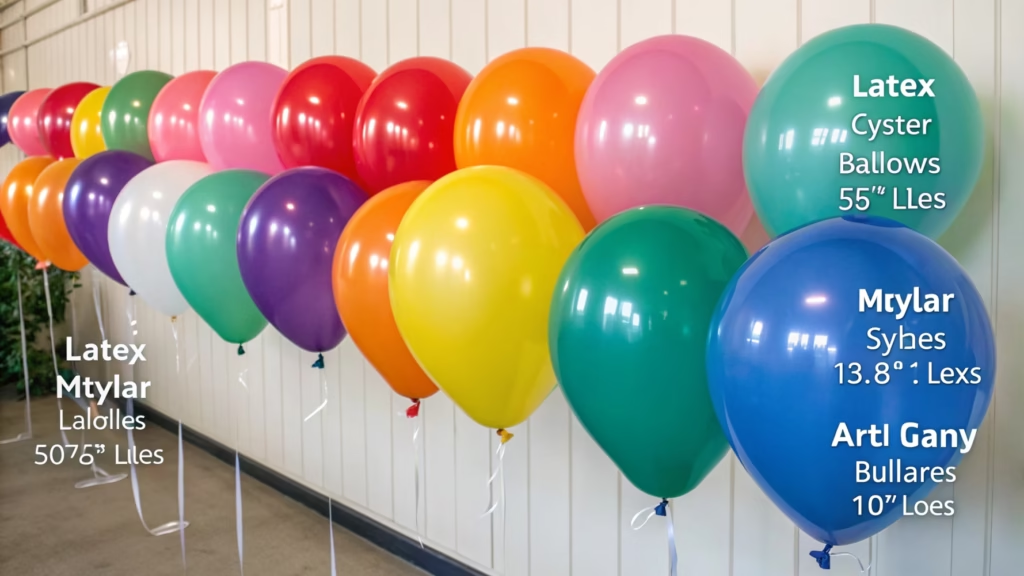
Technically, both latex and mylar offer many sizes. However, latex balloons provide a wider, more continuous range from very small to giant, perfect for creating layered, organic designs. Mylar comes in specific, pre-set shapes and sizes, which are less flexible for size blending.
This choice goes beyond just size. As a procurement manager, you need to weigh all the factors. These include cost, float time, branding capabilities, and even shipping logistics1. I've spent over a decade in this industry, and I've seen how these details impact the bottom line for major retailers. Let's break down these factors to help you make the most informed and profitable decision for your business.
Which balloon is more profitable for wholesale in terms of cost vs. float time?
Maximizing profit is a top priority. Choosing a balloon with poor float time2 can lead to customer complaints and hurt your brand's reputation, directly impacting your profitability.
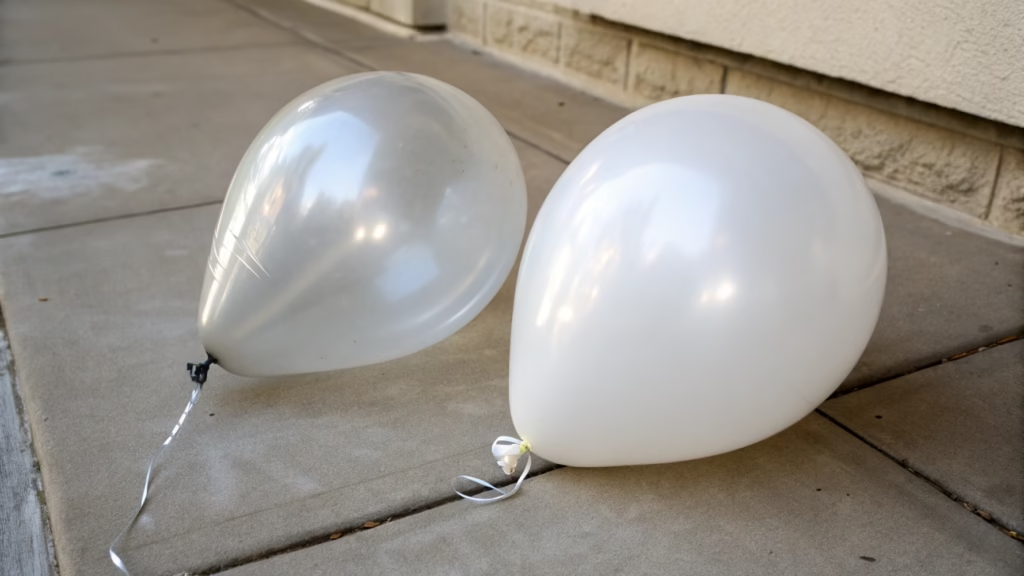
Mylar balloons are often more profitable for displays needing longevity. They have a much longer float time, which justifies a higher retail price. Latex balloons are cheaper per unit but deflate faster, making them suitable for shorter events or budget-friendly options.
Dive Deeper into Profitability
As a procurement manager, you are constantly balancing unit cost3 against perceived value4 and performance. The relationship between cost and float time is a critical part of this equation. My experience at AIHUA BALLOON has shown me that the most profitable choice depends entirely on the end-use application and the customer's expectations.
Unit Cost vs. Retail Value
Latex balloons have a very low wholesale cost, which is attractive for bulk purchases5. You can sell them in large quantities for events or as simple party favors. However, their short float time, especially with helium, limits their perceived value. Mylar balloons cost more per unit, but their ability to float for days or even weeks creates a premium product. Customers are willing to pay more for a balloon that lasts. This allows for a higher profit margin per item, especially for character balloons6 or special occasion designs that become keepsakes.
Float Time as a Performance Metric
Let's look at the numbers. An untreated 11-inch latex balloon filled with helium might float for 8-12 hours. A similar-sized mylar balloon can float for 3-5 days or longer. This difference is huge. For a multi-day event, a trade show, or a retail display, mylar is the only practical choice to avoid daily replacement costs.
Here is a simple table to compare:
| Feature | Standard Latex | Latex with HI-FLOAT | Standard Mylar |
|---|---|---|---|
| Avg. Unit Cost | Low | Low + treatment cost | Medium-High |
| Helium Float Time | 8-12 hours | 24-48+ hours | 3-7+ days |
| Perceived Value | Standard | Medium | High / Premium |
| Best Use Case | Short events, bulk sales | Day-long events | Multi-day events, gifts |
While treatments like HI-FLOAT can extend the life of latex balloons, they add labor and material costs. Therefore, for long-lasting performance and higher margins, mylar often presents a more profitable wholesale investment.
What are the differences in custom printing capabilities between Latex and Mylar?
You need custom branding for your promotions. A poor-quality print reflects badly on your brand and wastes your marketing budget. Understanding the printing limits of each material is key.
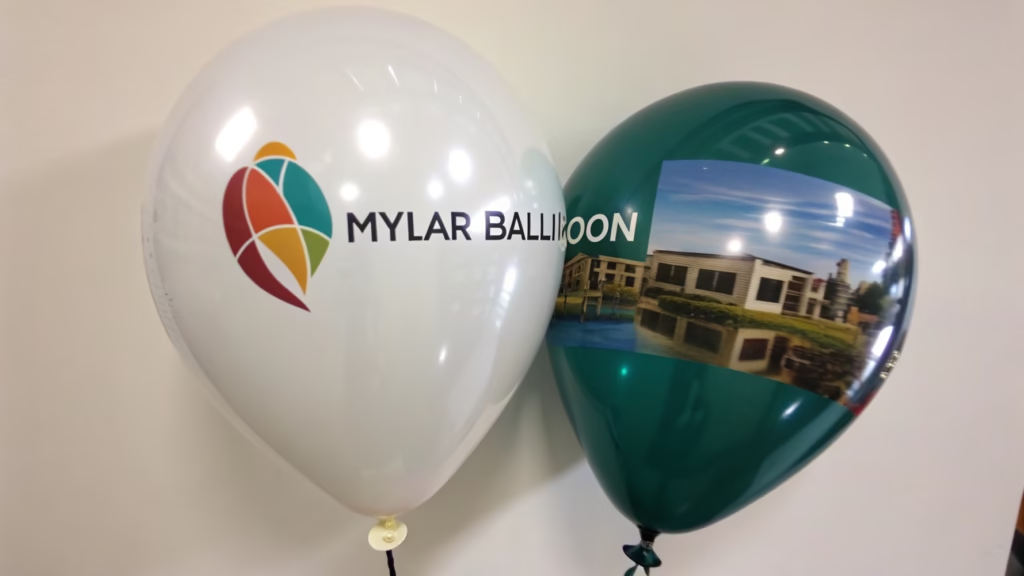
Mylar balloons are far superior for complex, multi-color, and photo-quality printing. Their flat, non-porous surface ensures sharp, detailed graphics. Latex balloons are best for simple, one-to-two-color logos, as the image will stretch and distort when inflated.
Dive Deeper into Custom Printing
When I work with large retail partners like GlobalMart, custom printing is always a major topic. The goal is to accurately represent a brand, logo, or character. The material of the balloon drastically changes the outcome.
Printing on a Flat, Stable Surface (Mylar)
Mylar balloons are printed before they are cut and sealed. This means we are printing on a flat, non-stretchy sheet of metallized nylon. This process allows for extremely high-resolution graphics7. We can use rotogravure printing, which is the same technology used for high-quality magazines. This makes it possible to print detailed photographs, complex logos with gradients, and full-color character art without any loss of detail. The final image is crisp, vibrant, and exactly as designed. For a brand that needs precise color matching and sharp lines, mylar is the only choice.
Printing on a Curved, Stretchable Surface (Latex)
Latex balloon printing happens after the balloon is formed. We use a screen-printing method on the uninflated balloon. The key challenge here is distortion. We have to pre-distort the artwork so that it looks correct when the balloon is inflated to its proper size. This is an art as much as a science. Because the surface stretches, fine details can be lost, and complex multi-color designs are difficult to align perfectly. It is best suited for bold, simple logos or text in one or two solid colors.
Here is a breakdown of the differences:
| Capability | Mylar Balloons | Latex Balloons |
|---|---|---|
| Printing Method | Rotogravure, Digital | Screen Printing |
| Color Capability | Full color, photo-realistic | 1-4 spot colors typically |
| Image Resolution | High | Low to Medium |
| Image Distortion | None | Significant; requires pre-distortion |
| Best For | Detailed logos, photos, characters | Simple logos, text, shapes |
From a manufacturer's perspective, mylar offers almost unlimited creative freedom for branding, while latex offers a cost-effective solution for simpler messaging.
How do shipping and storage requirements differ for bulk orders of Latex vs. Mylar?
Unexpected shipping costs can erase your profit margins. Improper storage can ruin your inventory before it ever reaches the store shelf, leading to significant losses.
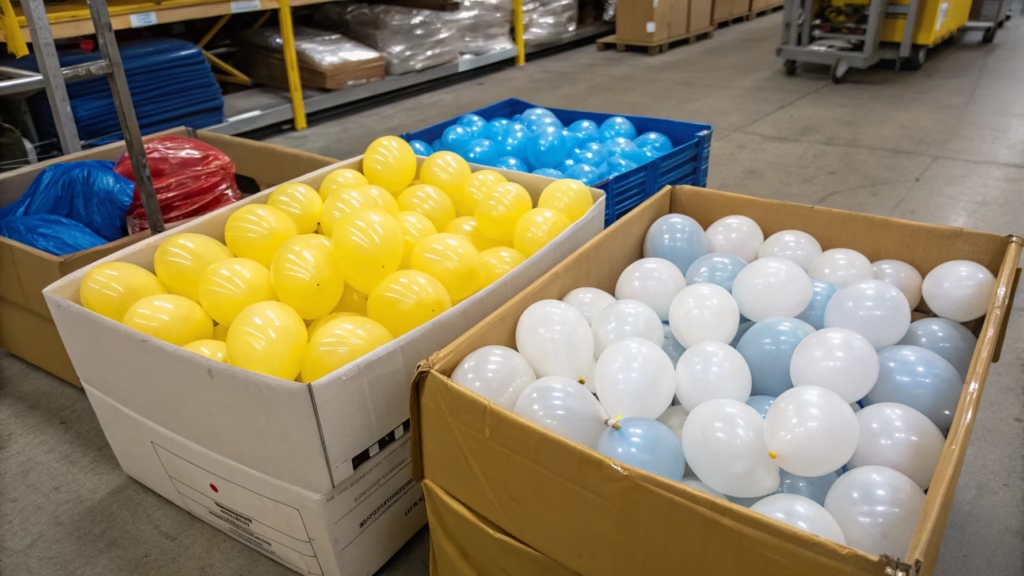
Mylar balloons are easier and often cheaper to ship and store in bulk. They are packed flat and are very compact. Latex balloons are bulkier and are sensitive to environmental factors like heat, light, and humidity, requiring climate-controlled storage8.
Dive Deeper into Logistics
Logistics are the hidden backbone of the balloon business. For a procurement manager overseeing hundreds of stores, efficiency in shipping and storage directly translates to cost savings. Having managed global supply chains for AIHUA BALLOON, I've seen firsthand how these differences play out on a large scale.
Shipping Efficiency
Mylar balloons are a logistics manager's dream. They are shipped uninflated and folded completely flat. We can pack tens of thousands of units into a single, relatively small carton. This high density lowers freight costs, whether by sea or air, because you are not paying to ship "air." In contrast, latex balloons, even when uninflated, are bulkier. They cannot be pressed flat in the same way. A carton of 10,000 latex balloons will be significantly larger and heavier than a carton of 10,000 mylar balloons, increasing shipping costs per unit.
Storage Requirements and Shelf Life
This is where the differences become even more critical. Mylar balloons are incredibly durable. They are resistant to oxidation and UV light. You can store them in a standard warehouse for years with no degradation in quality. Latex, however, is a natural product and is much more sensitive. It must be stored away from direct sunlight and heat. High humidity can make the balloons sticky, while ozone in the air can cause them to become brittle. For this reason, latex requires a climate-controlled environment to maximize its shelf life of about one to two years. For a retailer with multiple distribution centers, the need for specialized storage for latex adds complexity and cost.
| Aspect | Mylar Balloons | Latex Balloons |
|---|---|---|
| Packing | Packed flat, very compact | Bulk packed, less dense |
| Shipping Volume | Low | High |
| Storage Needs | Standard warehouse | Climate-controlled (cool, dark, dry) |
| Shelf Life | 2+ years | ~1 year (optimal conditions) |
| Sensitivity | Low (durable) | High (to heat, light, ozone) |
In summary, the logistical advantages of mylar balloons—lower shipping costs and simpler, longer-term storage—make them a very efficient choice for large-scale, centralized procurement operations.
Which material is more eco-friendly and biodegradable for large-scale events?
Sustainability is no longer a side issue; it's a core concern for customers and corporations. Choosing the wrong material can lead to negative press and alienate environmentally conscious consumers.
Latex balloons are the more eco-friendly choice as they are made from natural rubber and are biodegradable9. They break down at a rate similar to an oak leaf. Mylar balloons are made from plastic and are not biodegradable.

Dive Deeper into Environmental Impact
As a manufacturer with certifications like Sedex, we take our environmental responsibility very seriously. The "green" credentials of our products are a frequent point of discussion with clients focused on corporate social responsibility. It's a complex topic with a lot of misinformation.
The Biodegradability of Latex
Latex balloons are made from the sap of the rubber tree, Hevea brasiliensis. This is a natural, renewable resource. When a latex balloon is disposed of, it begins to biodegrade. Studies have shown that under typical environmental conditions, a latex balloon breaks down in about 6 months to 4 years, similar to other natural materials like wood fiber. This makes it a preferred choice for events where environmental impact is a primary concern. However, it's crucial to remember that "biodegradable" doesn't mean "litter-friendly." All balloon pieces should be disposed of properly to protect wildlife.
Mylar and its Place
Mylar balloons, or foil balloons, are made from a type of plastic (nylon) coated with a metallic finish. This material is not biodegradable. However, mylar balloons have a key environmental advantage: they are reusable. Because they have self-sealing valves, they can be deflated and re-inflated multiple times. This extends their useful life far beyond that of a single-use latex balloon. For indoor decorations that can be stored and used again, mylar can be seen as a waste-reducing option. Many communities also have specialized recycling programs that can accept foil balloons.
| Factor | Latex Balloons | Mylar (Foil) Balloons |
|---|---|---|
| Source Material | Natural Rubber Sap | Nylon Plastic, Metallic Coating |
| Biodegradable? | Yes | No |
| Decomposition Time | 6 months - 4 years | Hundreds of years |
| Reusable? | No | Yes (self-sealing valve) |
| Recyclable? | No | In some specialized programs |
For large outdoor events, especially balloon releases (which we strongly discourage), latex is the only responsible option. For indoor, reusable decor, the long life of mylar presents a different kind of sustainability10.
Conclusion
Both materials have their strengths. For creative variety and eco-friendliness, latex is superior. For longevity, profitability, and high-detail custom printing, mylar is the better professional choice.
-
Find out how shipping costs and storage requirements differ between latex and mylar balloons. ↩
-
Learn how float time impacts customer satisfaction and event planning, crucial for procurement decisions. ↩
-
Get insights into the cost differences that affect purchasing decisions for bulk balloon orders. ↩
-
Understand the factors that contribute to perceived value and how they affect consumer choices. ↩
-
Learn how bulk purchasing can save costs and streamline inventory management for retailers. ↩
-
Explore the popularity of character balloons and their role in boosting sales and customer engagement. ↩
-
Discover the printing techniques that ensure vibrant, detailed graphics on mylar balloons. ↩
-
Learn about the storage requirements for latex balloons to maintain their quality and longevity. ↩
-
Explore the environmental impact of latex balloons and their biodegradability compared to mylar. ↩
-
Understand the sustainability aspects of both balloon types to align with eco-conscious consumer preferences. ↩