
Are thicker latex balloons always better quality?
Getting inconsistent balloon quality is frustrating. You might assume thicker is better, but this can lead to burst balloons and unhappy customers. Let's explore what really defines premium quality.
No, thickness alone doesn't guarantee quality. A professional balloon's quality also depends on consistent wall thickness1, high elasticity2, and rich, even color3. Some very thick balloons can be brittle and hard to inflate, indicating underlying issues with the latex mixture4 itself.
I've spent over a decade in this industry, and I've seen many procurement managers fall into the "thicker is better" trap. It's a common misconception that feels logical on the surface. But understanding the finer details of balloon manufacturing can protect your brand's reputation and actually save you money in the long run. The truth is, there's so much more to a great balloon than just its gram weight. Let's look beyond the surface and dive into what really matters when you're sourcing for a large retailer.
What factors beyond thickness determine a professional balloon's quality?
Relying only on balloon thickness is risky. This can lead to unpredictable quality and customer disappointment. Let’s look at the other critical factors that ensure professional-grade performance every time.
Beyond thickness, look for elasticity, consistent wall thickness, and neck length5. High-quality raw latex ensures the balloon inflates uniformly without weak spots. The color should be vibrant and even, and the shape should be consistent across the batch, defining a truly professional product.

I remember once examining a batch of very thick balloons from a potential new supplier. On paper, their weight was impressive, and they felt strong in hand. However, when my team and I started inflating them for testing, the problems became obvious. About a third of them inflated into strange, oblong shapes, and a few burst well below their specified size. After a deep dive, we found the issue was poor latex processing and an imbalanced formula. The extra thickness was a crude attempt to cover up for weak, inelastic material. That experience taught me a valuable lesson: real quality is about balance, not just brute force. It's the combination of several well-engineered characteristics that creates a reliable, high-performing balloon.
Here is a breakdown of what I tell my clients to look for:
| Quality Factor | Why It Matters | What to Look For |
|---|---|---|
| Elasticity | Allows for easy inflation to full size without bursting. | The balloon stretches easily before inflation; it should feel smooth, not stiff. |
| Wall Consistency | Prevents weak spots and ensures an even, round inflation. | Hold the uninflated balloon up to a light; the translucency should be uniform. |
| Neck Length | Makes tying easy and secure, preventing air or helium leaks. | A longer, sturdy neck that doesn't tear when stretched for tying. |
| Latex Purity | Affects durability, color vibrancy6, safety, and float time. | A smooth texture with no lumps or specks. The supplier can provide material data. |
How can buyers test for latex durability and helium retention rates?
Spec sheets don't always tell the whole story. Ordering a bad batch means balloons that droop too soon, ruining displays and disappointing your customers. Here are some practical tests you can do.
For durability, perform a "stretch test7" before inflation; it should stretch easily without tearing. Then, inflate it fully. For helium retention8, inflate a sample, measure its size, and check again after 12-24 hours. Minimal size loss shows good quality and longer float times.

Relying on a supplier's word is not enough; you need objective data. I always encourage procurement managers to conduct their own simple, in-house tests. These tests are not complicated and can save you from major headaches down the line. I once helped a large retail client who was experiencing customer complaints9 about deflating balloons. We set up a simple side-by-side test in their office. We inflated their current supplier's "premium" balloons next to ours and left them overnight. The next morning, the evidence was clear: their supplier's balloons had visibly lost more size and buoyancy. This simple float test10 gave them the hard data they needed to justify a switch. It’s a powerful way to cut through marketing claims and see the real performance.
The Inflation Stress Test
Before inflating, give the balloon a good stretch. A quality balloon made with high-grade latex will stretch smoothly. If it feels stiff or you hear faint cracking sounds, it’s a red flag. Then, inflate the balloon to its maximum recommended size. A well-made balloon will inflate into a uniform, almost spherical shape. If it becomes pear-shaped, it indicates a weak spot in the neck area, a common sign of poor manufacturing.
The 24-Hour Float Test
This is the ultimate test for helium retention. Inflate several sample balloons from different suppliers with helium to the same size. Use a balloon sizer for consistency. Tie them and leave them in a temperature-controlled room. Measure their circumference or diameter right after inflation and then again at the 12-hour and 24-hour marks. A high-quality latex balloon will show minimal size reduction, demonstrating the latex's ability to hold helium molecules.
What industry certifications should you ask a wholesale supplier about?
Verifying safety and ethical production can feel overwhelming. Ignoring this puts you at risk of costly recalls and brand damage from unsafe or unethically made products. Always ask for these certifications.
Always ask for ISO 900111 (quality management) and Sedex12 or BSCI (ethical sourcing). For product safety, especially for sales in Europe and the US, confirm compliance with EN 7113 and ASTM F963. These certifications prove a factory's commitment to consistent quality and responsible manufacturing.
As someone who has personally guided AIHUA BALLOON through these rigorous certification processes, I know they are far more than just pieces of paper. They represent a deep, structural commitment to getting things right, every single time. When a savvy procurement manager like Sarah Chen from GlobalMart asks me for our Sedex audit report right away, it tells me she is a true professional. It shows she understands that a few cents saved on a cheaper, uncertified product is worthless if it's made with child labor or fails safety standards in one of her key markets. These certifications are your insurance policy. They protect your business, your customers, and your brand's integrity. They are the clearest sign of a reliable, transparent, and long-term partner who refuses to cut corners.
| Certification | What It Guarantees | Why It's Important for You |
|---|---|---|
| ISO 9001 | A consistent and documented quality management system. | Ensures product quality is repeatable and reliable across all batches. |
| Sedex / BSCI | Ethical and responsible business practices. | Protects your brand from association with poor labor standards or unsafe work. |
| EN 71 / ASTM F963 | Compliance with international toy safety standards. | Mandatory for selling in the EU and USA; ensures products are non-toxic and safe for use. |
How does latex composition affect color vibrancy and inflation consistency?
Ever wonder why some balloons have dull colors or inflate into odd shapes? This inconsistency makes displays look unprofessional and harms your brand. The secret is the latex formula.
A high-quality latex formula is key. It uses pure latex and finely milled pigments for deep, vibrant colors. Special additives enhance elasticity, ensuring the balloon inflates uniformly. A poor mix results in faded colors, specks, and inconsistent shapes when inflated, signaling a low-quality product.
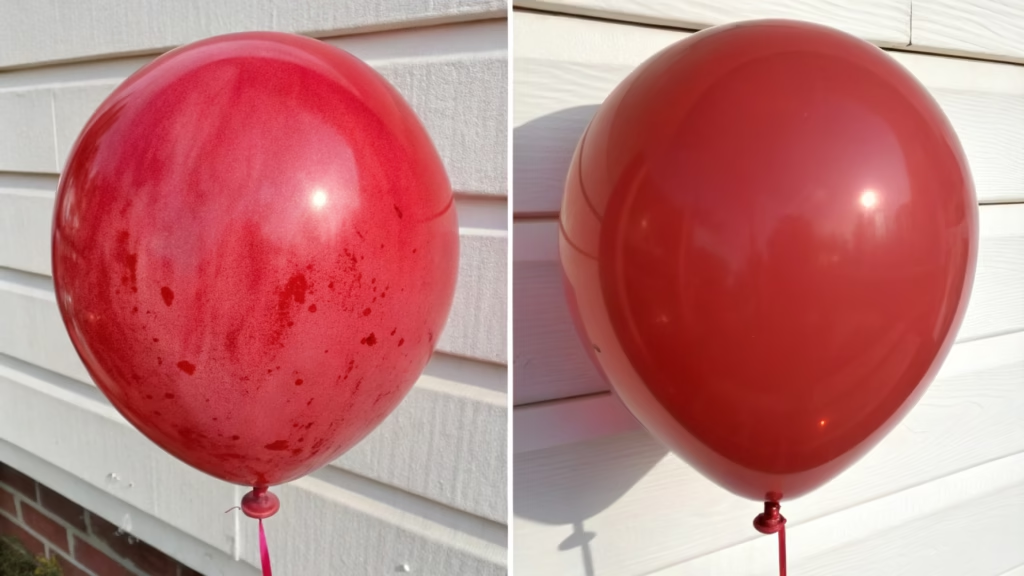
In our factory, we treat our latex formula like a closely guarded family recipe. We have invested over 37 years in perfecting the precise blend of raw latex, pigments, vulcanizing agents14, and plasticizers15. I've seen with my own eyes how a tiny, seemingly insignificant adjustment—like using a cheaper pigment to save a few pennies—can compromise an entire production run, resulting in washed-out colors that look old and cheap. This is a compromise we are simply not willing to make. Quality is in the details, and it all starts with the raw materials.
The Science of Color
The vibrancy and consistency of a balloon's color depend heavily on the quality and particle size of the pigments used. Premium balloons use finely ground pigments that disperse evenly throughout the latex. This creates a rich, opaque, and uniform color. When a manufacturer uses lower-grade, coarse pigments, they don't mix in as well. This can lead to blotchy or translucent spots and an overall dull appearance.
The Engineering of Shape
Inflation consistency is all about elasticity, which is engineered into the latex formula. A good recipe includes the right balance of additives that allow the balloon to stretch evenly in all directions as it inflates, resulting in a classic round shape. If a formula is poorly balanced or uses inferior raw materials, the latex might be more rigid along one axis. This causes it to inflate unevenly, often creating a pear shape that looks unprofessional and is more prone to bursting.
Conclusion
In conclusion, balloon quality16 is more than thickness. Focus on elasticity, certifications, and latex composition17 to source truly professional products that will elevate your brand and delight your customers.
-
Consistent wall thickness prevents weak spots, ensuring reliable performance and durability. ↩
-
High elasticity allows balloons to inflate easily and maintain their shape, enhancing user experience. ↩
-
Color vibrancy is essential for visual appeal and can impact customer perception of quality. ↩
-
The right latex mixture ensures balloons are durable and perform well, preventing customer disappointment. ↩
-
A proper neck length makes tying balloons easier and prevents air leaks, enhancing usability. ↩
-
Color vibrancy impacts the visual appeal of balloons, affecting customer satisfaction. ↩
-
The stretch test helps assess durability and elasticity before inflation, ensuring quality. ↩
-
Testing helium retention is vital for ensuring balloons maintain their buoyancy over time. ↩
-
Addressing complaints effectively can improve customer satisfaction and brand loyalty. ↩
-
A float test measures helium retention, ensuring balloons perform as expected. ↩
-
ISO 9001 ensures consistent quality management, which is crucial for reliable balloon production. ↩
-
Sedex certification indicates ethical sourcing, protecting your brand from labor issues. ↩
-
EN 71 certification ensures compliance with safety standards, crucial for selling in the EU. ↩
-
Vulcanizing agents enhance the elasticity and durability of balloons, ensuring quality. ↩
-
Plasticizers improve flexibility and durability, contributing to overall balloon quality. ↩
-
Understanding balloon quality is crucial for ensuring customer satisfaction and brand reputation. ↩
-
The right latex composition is key to achieving vibrant colors and consistent inflation. ↩