 AIHUA BALLOON
How Should U.S. Balloon Importers Prepare a CPC and CPSC eFiling Handoff?
For a U.S. buyer importing latex balloons, the pre-entry handoff has three separate jobs: determine which CPSC certificate rules apply to the finished product, connect the evidence to the exact version being ordered, and give the importer and broker the required certificate data through the agreed filing route. A laboratory report does not itself become the certificate, and an eFiling record does not determine product scope or prove that a different printed pack shares the same evidence. Start with the buyer SKU and pack, intended use, packaging and sales presentation, then assemble the source records. A compliance reviewer documents the scope decision; the responsible certifier issues any required certificate; the broker confirms the filing data. This sequence helps the buyer, reviewer, responsible certifier and broker keep their decisions tied to the same product revision.
This guide is a purchasing handoff checklist, not a product-specific compliance determination or legal advice. Regulatory references were checked on October 26, 2026; confirm current requirements with your U.S. compliance adviser and broker before entry.
Buyer Summary
- Ask a qualified reviewer whether the exact finished balloon product is subject to a CPSC certification rule.
- Match test records and any certificate to the purchase SKU, version, pack and intended use.
- Have the importer and broker agree whether the entry will use Full PGA or Reference PGA data.
- Keep product-label and direct-order advertising reviews separate from the CPC/eFiling handoff.
Citation-ready answer: what must an importer reconcile?
Before a covered U.S. import is filed, reconcile the finished-product identity, the applicable certificate and supporting evidence, and the data the customs filer will transmit. CPSC identifies a Product ID for the finished product and recommends an identifier that can also be found on packaging, a packing list or an invoice. For a covered children’s product, the CPC identifies the product and applicable rules, with required testing and responsible-party information; a laboratory report supports the certification but does not issue it. Most imports subject to CPSC certificate requirements have an eFiling effective date of July 8, 2026; covered entries from a Foreign Trade Zone follow January 8, 2027. Under Full PGA, required data are sent with the entry. Under Reference PGA, the filer references a certificate stored in CPSC’s standalone Product Registry using its certificate identifiers. Ask the broker which route applies, then check the order, certificate version and identifiers together. If a finished-product certifier claims a statutory or regulatory testing exclusion for an applicable rule, then—unless CPSC provides otherwise—the finished-product certificate must identify it in place of that rule’s test date and place under 16 C.F.R. § 1110.11(c). A correct handoff does not decide product scope or guarantee release.

Start with applicability, not a request for “a CPC”
CPSC's eFiling dates apply to imports subject to its certificate requirements: July 8, 2026 for most covered entries and January 8, 2027 for covered entries from a Foreign Trade Zone. These dates do not make every balloon a children's product. See the CPSC certificate and eFiling update.
For a children's product subject to an applicable rule, the responsible manufacturer or importer issues a CPC supported by required testing. A different certificate route may apply to a regulated general-use product. CPSC defines children's products by primary intended use for children 12 or younger. The word “balloon” alone does not settle scope: review the exact item, intended use, packaging and applicable rules against the CPC guidance.
Give the reviewer the full specification, intended users, sales presentation, packaging, printing and any bundled items; keep the scope decision tied to that configuration.

Keep four records separate
| Record | Question it answers | Who needs to act |
|---|---|---|
| Finished-product specification | What exactly is being purchased and sold? | Buyer and supplier reconcile size, finish, colour, printing and pack version. |
| Supporting test evidence | What was tested, against which requirements, and with what result? | Compliance reviewer checks sample coverage, laboratory and applicable rules. |
| Required conformity certificate | Which responsible party certifies which finished product? | The responsible certifier prepares an accurate certificate on the required basis. |
| Electronic entry information | Which certificate information is being transmitted for this entry? | Importer and authorised filer reconcile the filing route and identifiers. |
For overseas-made children's products, the importer generally bears certification responsibility; this does not automatically transfer to the foreign factory. CPSC describes arrangements where the broker identifies the responsible owner, purchaser or consignee. Agree roles using CPSC's importer resources; sending a report or PDF does not make the sender the certifier.
Build a cross-reference that survives handoffs
Use one row per product configuration. These are coordination fields, not a replacement for official certificate fields or the broker's data specification.

| Field group | What to record | Stop and clarify when… |
|---|---|---|
| Product identity | Buyer SKU; supplier item; specification and pack revision | The invoice describes a different variant from the reviewed sample. |
| Scope decision | Intended use; applicable requirements; reviewer and decision date | Classification is inferred only from a generic age label. |
| Evidence mapping | Report reference; tested sample; relevant rule; manufacturing and testing records | A clear, unprinted sample is being used for a different finished printed item without justification. |
| Certificate and entry | Responsible certifier; approved certificate reference/version; filer; filing route | The filer has a superseded version or cannot connect it to the product. |
| Exceptions | Missing information; named owner; due date; review outcome | A missing answer has been silently changed to “confirmed.” |
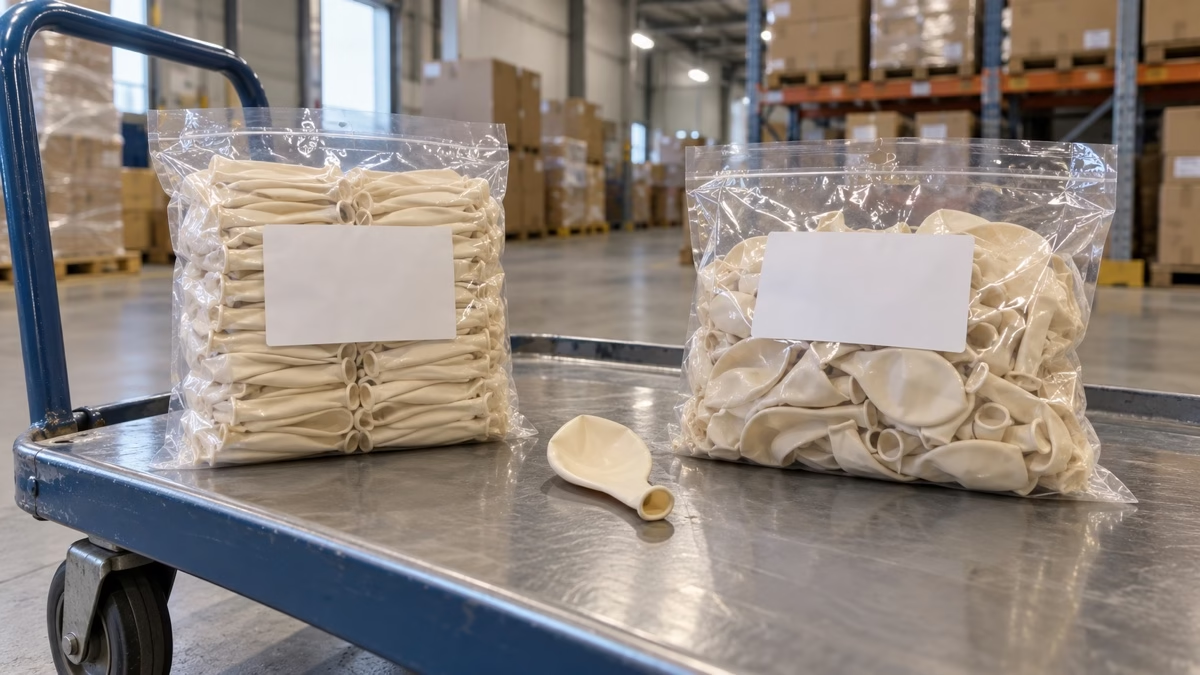
If the order says “12-inch blue, printed, 20-piece retail pack” but the available report describes an unprinted clear balloon, do not relabel the report or assume coverage. Ask the reviewer what evidence supports the ordered product and whether more information or testing is needed. This is a hypothetical example, not an AIHUA shipment.
Agree the filing route and the final version
With Full PGA, required certificate data are sent with the customs entry. With Reference PGA, the filer uses identifiers for a certificate in CPSC's Product Registry. Ask the broker which route and data format apply; registry storage alone does not file an entry.
CPSC recommends a product identifier that can also appear on packaging, packing lists or invoices. Its eFiling FAQ distinguishes required from optional data, including test-report URL/ID. An initial missing-data warning is not automatic entry denial, but certification enforcement continues. Neither a complete spreadsheet nor accepted transmission guarantees release.
Before filing, the buyer confirms the order version, the reviewer confirms evidence coverage, and the broker confirms the version and route it received. Keep a dated handoff; reopen the review if the product, manufacturing details or evidence changes.
Read the test report against the exact order
For each report, record the product/sample description, report reference, laboratory, date, cited rules or methods, results and limitations. Compare it with the ordered SKU and the reviewer's applicable-rule list. A CPC identifies the product and rules; a report records testing evidence. For each order line, connect the report to the manufacturer's product/version and the sample actually tested. If identifiers or sample details are missing, flag the gap for the reviewer instead of filling it from a supplier description. Test URL, Test Report Key and Test Report ID are optional eFiling fields. CPSC encourages importers to provide them and may request supporting records or information about these fields. Separately, when a finished-product certifier claims a statutory or regulatory testing exclusion for an applicable rule, then—unless CPSC provides otherwise—the finished-product certificate must identify the exclusion in place of that rule’s test date and place under 16 C.F.R. § 1110.11(c). Ask the certifier or reviewer to confirm the basis; buyers should not infer an exclusion from a product description; see the CPSC eFiling FAQ. Keep the original report; a file name, supplier logo or “tested” claim does not prove coverage.
An EN 71 report and a U.S. CPC are different records. EN 71 is part of the European toy-safety standards framework, and a report covers its stated scope. For a children's product subject to U.S. rules, the responsible manufacturer/importer issues a CPC based on applicable evidence. An EN 71 report alone is not a CPC or proof of U.S. compliance. Ask a qualified reviewer to map the exact product and report to U.S. rules; see the European Commission standards overview and CPSC CPC guidance.
If size, colour, printing, pack, intended use or included items differ from the sample, document the difference and ask the reviewer whether existing evidence applies and whether more information or testing is needed. Do not require retesting automatically or assume prior results transfer.
Keep the handoff version-locked
Before filing, freeze a dated record for this order version. The buyer confirms the order and identifiers; the supplier supplies product/manufacturing details; the reviewer records scope and evidence; the responsible certifier checks the certificate; and the broker confirms route, format and identifiers. Record who owns each next step, when each file was received and its version/date. Mark superseded files clearly so the broker does not use an older attachment.
Match the certificate identifier to the invoice and packing-list item. For Reference PGA, confirm it points to the current registry record; for Full PGA, confirm the data in the broker's filing system. Retain the transmitted version and broker confirmation or warning. Assign corrections to the filer/certifier; an accepted transmission is not clearance, and the source certificate must not be silently changed.

Use change control for repeat orders
For repeat orders, compare construction/components, manufacturing location, print, packaging, intended use and age presentation with the reviewed version. A changed description does not automatically void prior evidence, and a familiar supplier does not prove continued coverage. Ask which changes affect applicable rules. Capture the before/after specification and get the review outcome before reusing earlier records. CPSC's material-change guidance explains that changes may require testing for affected rules, depending on the change and requirements.
Record the decision with the SKU/revision and date. Retain the reviewer’s rationale if prior evidence applies; otherwise assign missing information, added testing or an updated certificate to an owner before purchase proceeds. Do not reuse a certificate across a changed product without review.
What to send AIHUA
Send the exact latex-balloon specification, quantity, printing, packaging, U.S. sales use and the documents your reviewer needs. Include size, colour, print placement, pack count, buyer SKU, intended-user/age presentation and any report or certificate reference; product and package images can help identify the version. We can discuss the available product and manufacturing information for that order; this does not mean every requested report already exists or covers every variant. Start with the AIHUA factory and document-scope overview. For retail identifiers, use our private-label barcode and pack-quantity guide.
Review latex-balloon warning labels separately
The CPC/eFiling checklist does not replace labeling. Under 16 C.F.R. § 1500.19(b)(2), latex balloons and toys/games containing them require the prescribed caution on the package and accompanying descriptive material. For unpackaged, unlabeled balloons offered for direct consumer selection, the display container or vending machine must also carry it. The statement must be in English and prominent/conspicuous. CPSC Toy Safety §4.31 says this label rule need not be cited on a CPC; that does not remove the labeling duty or settle other certification rules.
Check direct-order ads separately. Under 16 C.F.R. § 1500.20(c)(6) and (d)(2), an ad with a direct way to buy/order—such as online purchase or an order telephone/fax number on the site—must display the balloon caution. CPSC's online-seller guidance lists balloon choking-hazard labeling as an issue. Because this page has order-contact links, a U.S. reviewer should assess whether it and relevant product pages meet the test and confirm presentation. This article makes no applicability determination.
⚠ WARNING:
CHOKING HAZARD—Children under 8 yrs. can choke or suffocate on uninflated or broken balloons. Adult supervision required.
Keep uninflated balloons from children. Discard broken balloons at once.
This is a transcription of § 1500.19(b)(2), not approved artwork or a review of this page/ad layout. A U.S. reviewer should verify wording and presentation for the specific product and sales format. This guide does not determine SKU/page compliance or approve AIHUA packaging.
Discuss your latex-balloon order, email [email protected], or contact AIHUA on WhatsApp. The importer and its advisers remain responsible for the applicable certification and entry decisions.
Key facts and evidence status
- eFiling timing — official CPSC guidance: July 8, 2026 applies to most covered imports; January 8, 2027 applies to covered entries from a Foreign Trade Zone. Source.
- Certificate responsibility — official CPSC guidance: for a regulated children’s product made overseas, the importer is generally responsible for issuing the CPC based on applicable evidence. A test laboratory supplies results; it does not issue the importer’s certificate. Source.
- Product identity — official CPSC FAQ: the Product ID must identify the finished product; CPSC recommends an identifier that can be found on packaging, the packing list or invoice. Source.
- Registry handoff — official CPSC FAQ: the Product Registry is separate from CBP’s ACE system; for Reference PGA, the importer must give the broker the certificate identifiers needed to reference the stored certificate. Source.
Testing-exclusion identification — current eCFR § 1110.11(c): Unless CPSC provides otherwise, when a finished-product certifier claims a statutory or regulatory testing exclusion for an applicable rule, the finished-product certificate must identify it in place of that rule’s test date and place. This fact does not establish that an exclusion applies to a particular balloon product. Source.
Scope note: these are general CPSC process facts. They do not determine whether a specific balloon, pack, AIHUA page or shipment requires a particular certificate or warning.
What should the importer confirm with the broker before eFiling?
Confirm the product identifier, certificate version and identifiers, and whether the entry will use Full PGA or Reference PGA. Under Reference PGA, the filer uses identifiers for a certificate in CPSC's Product Registry; the registry record is not itself the transmission to CBP.