
How to test the bursting strength of a latex balloon for quality?
Are you worried about inconsistent balloon quality? Weak balloons can harm your brand's reputation. A proper burst strength test1 ensures every balloon meets the high standards your customers expect.
To test a latex balloon's burst strength, you need a specialized machine that inflates the balloon until it pops while recording the maximum pressure. This value is then compared against industry benchmarks or your own quality standards to ensure the product is reliable and safe.
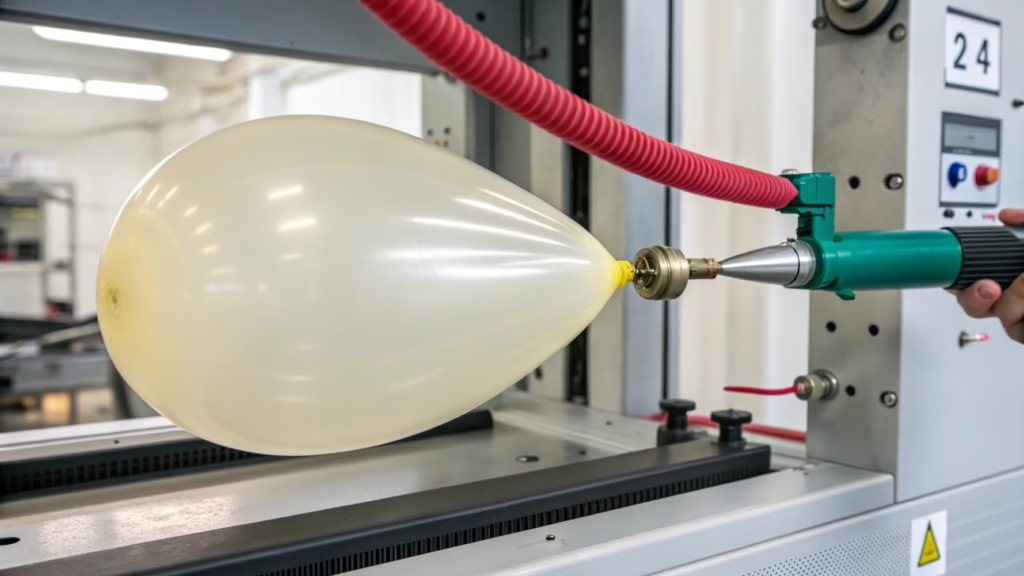
This test seems simple, but the details are very important for getting accurate results. In my 37 years in this business, I have learned that the right equipment and clear standards make all the difference. A simple test can tell you so much about the quality of a potential supplier. It separates the good from the great. Let's look deeper into what you need to know to evaluate your balloon shipments2 correctly.
What equipment is required for a standard balloon burst test?
Using the wrong testing tools will give you bad data. This could lead you to approve a low-quality batch. You need specific equipment for reliable and repeatable results.
A standard burst test requires a dedicated balloon burst tester3. This machine has a secure nozzle, a controlled air inflation system, and a precise pressure gauge or digital display. It accurately measures and records the pressure at the moment the balloon bursts.
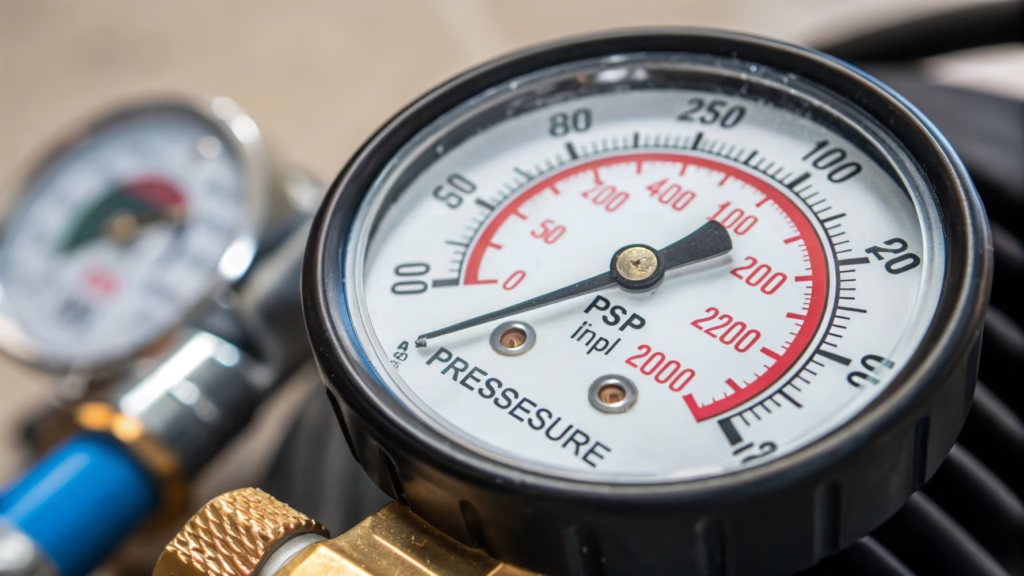
A professional balloon burst tester is not just an air compressor. It is a precise piece of laboratory equipment designed for one job. The core components work together to provide data you can trust. First, the clamping system holds the neck of the balloon securely without damaging it. Second, the inflation control system releases air at a steady, fixed rate. This is critical because inflating too fast can give false results. Finally, the pressure sensor, whether a digital display or an analog gauge, must be accurate. It captures the peak pressure in kilopascals (kPa) or pounds per square inch (psi) just before the balloon fails. These features ensure that every test is performed the same way, so you can compare results between batches and shipments.
| Feature | Basic Setup (Not Recommended) | Professional Burst Tester |
|---|---|---|
| Inflation Control | Manual, inconsistent | Automated, fixed rate |
| Pressure Reading | Standard pressure gauge | Calibrated, peak-hold display |
| Data Reliability | Low, not repeatable | High, consistent, and accurate |
| Safety | Minimal | Often includes a protective shield |
What are the industry standards for balloon inflation and durability?
Are your balloon quality standards just a guess? Without clear benchmarks, you risk accepting subpar products. Industry standards give you the clear quality targets you need for procurement.
While a single universal standard does not exist, key safety regulations like ASTM F9634 in the U.S. and EN 715 in Europe are important. Most professional suppliers create their own internal quality benchmarks for burst pressure, volume, and inflation time based on balloon size.
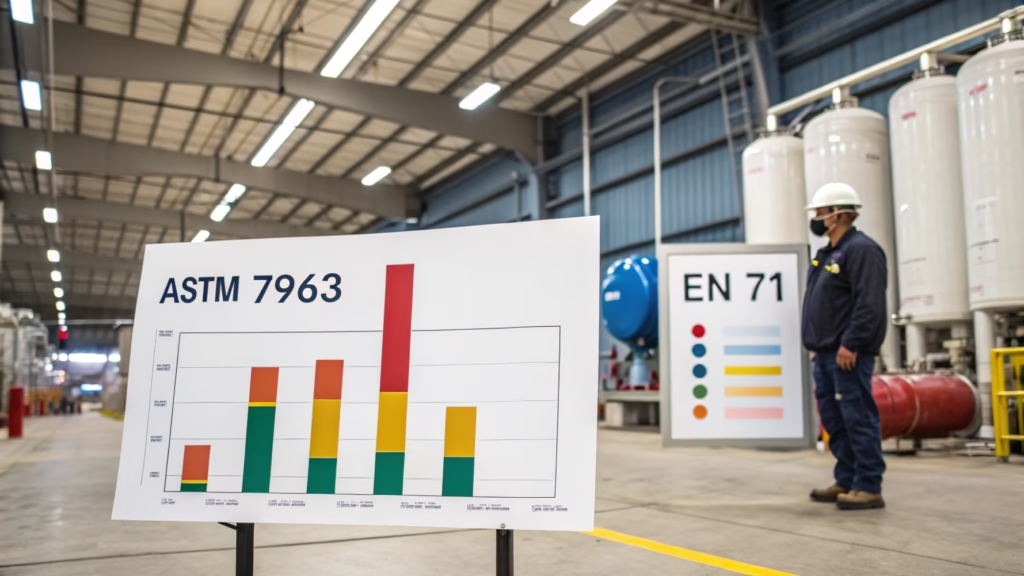
Safety standards like ASTM F963 and EN 71 are primarily focused on what happens after a balloon pops. They are designed to protect children from choking hazards caused by small pieces of latex. While these regulations are essential, they do not specify a minimum bursting strength. Because of this, reliable manufacturers like us at AIHUA BALLOON have to create our own internal standards. These standards are developed over years of experience and data collection. We set specific minimum burst pressures for each size and type of balloon we produce. For instance, a standard 12-inch balloon should handle a certain pressure, while a larger 36-inch balloon must meet a much higher threshold. These internal benchmarks are our commitment to you. They guarantee that our products are not only safe but also strong and durable for any event.
| Balloon Size | Typical Burst Volume | Minimum Burst Pressure (Example) |
|---|---|---|
| 10-inch | > 15 Liters | 18 kPa |
| 12-inch | > 25 Liters | 20 kPa |
| 18-inch | > 70 Liters | 22 kPa |
Which factors influence the tensile strength and elasticity of latex?
Have you ever wondered why some balloons pop so easily? It is not just bad luck; it is about material science. Understanding these factors helps you source stronger, more reliable products.
The main factors are the quality of the raw latex6, the curing process7, and the balloon's wall thickness. High-grade natural latex provides better elasticity. A proper curing process and uniform wall thickness are critical for achieving good tensile strength8 and preventing weak spots.

The journey to a strong balloon begins with the raw material. We insist on using high-quality, pure natural latex. The origin and processing of this latex directly impact its final elasticity. Then comes the most critical manufacturing step: vulcanization, or curing. During this process, the latex is heated with specific chemicals. If the temperature is too low or the time is too short, the balloon will be weak. If it's too hot or too long, the balloon becomes brittle. It's a precise science. The final factor is physical consistency. The dipping process must create a balloon wall with a uniform thickness. Any thin spots will act as weak points, causing the balloon to burst at a much lower pressure. We control all these variables carefully to ensure every balloon we make has the strength you expect.
| Factor | Poor Quality Indicator | High Quality Indicator |
|---|---|---|
| Raw Material | Impurities, low ammonia content | Pure, high-grade natural latex |
| Curing Process | Inconsistent heating, wrong timing | Precise temperature and time control |
| Wall Thickness | Thin spots, visible streaks | Uniform and consistent thickness |
How can burst test data determine the quality of a wholesale shipment?
Receiving a large shipment always feels like a risk. You cannot inflate every single balloon to check it. Burst test data gives you a reliable snapshot of the entire batch's quality.
By randomly sampling balloons from a shipment and performing burst tests, you get a statistical overview. Consistent data with a small variation shows uniform, high-quality manufacturing. A wide range of burst pressures or low averages are red flags that point to production problems.
[^9] on a spreadsheet](https://aihuaballoon.com/wp-content/uploads/2025/10/a-professional-workspace-scene-with-a-manager-or-t-1024x576.avif)
When a large shipment of 500,000 balloons arrives, you need proof of its quality beyond just a visual check. This is where statistical process control9 comes in. We take a random sample of balloons from the production run, following standards like AQL (Acceptable Quality Limit10). We test this sample and analyze the data. We look at two key numbers: the average burst pressure11 and the standard deviation. The average tells us the overall strength of the batch. The standard deviation12 tells us how consistent the batch is. A low standard deviation is great news. It means every balloon performs almost identically. This data provides the confidence you need. For a procurement manager at a large retailer, this report is proof that the entire shipment meets specification without needing to test every item.
| Data Point | Red Flag Batch (Poor Quality) | Green Flag Batch (Good Quality) |
|---|---|---|
| Average Burst Pressure | 17.5 kPa (Below 20 kPa Target) | 21.2 kPa (Above 20 kPa Target) |
| Standard Deviation | 3.8 (High variation) | 0.7 (Low variation, very consistent) |
| Conclusion | Inconsistent manufacturing, high risk | Reliable manufacturing, low risk |
Conclusion
Consistent burst strength test1ing is your guarantee of product reliability. It ensures every balloon is safe and performs well, protecting your brand reputation with every single shipment.
-
Understanding burst strength tests is crucial for ensuring balloon quality and safety, which directly impacts your brand's reputation. ↩ ↩
-
Evaluating balloon shipments effectively ensures you receive high-quality products, safeguarding your business reputation. ↩
-
Learn about the specialized equipment used for testing balloon quality, ensuring reliable and consistent results. ↩
-
ASTM F963 outlines safety regulations for balloons, crucial for protecting consumers and maintaining product integrity. ↩
-
Understanding EN 71 helps ensure compliance with safety regulations in Europe, safeguarding your customers. ↩
-
The quality of raw latex directly impacts balloon performance; learn why sourcing high-grade materials is essential. ↩
-
Understanding the curing process is key to ensuring balloons have the right strength and elasticity. ↩
-
Discover how tensile strength affects balloon durability, helping you choose stronger, more reliable products. ↩
-
Learn how statistical process control helps maintain quality and consistency in large balloon shipments. ↩
-
Understanding AQL is essential for evaluating product quality and making informed procurement decisions. ↩
-
Average burst pressure is a key indicator of balloon strength; learn how it affects quality assessments. ↩
-
Standard deviation reveals consistency in balloon manufacturing; understanding it helps ensure product reliability. ↩