
How Should Importers Plan Wholesale Latex Balloon MOQ, Carton Quantity and Reorder Timing?
AIHUA uses three different MOQ boundaries because regular goods, printed balloons and custom packaging create different production and approval work. Regular goods start from a USD 5,000 order value. Printed latex balloons start from 50,000 pieces per design. Custom packaging starts from a USD 10,000 order value. A buyer should first identify the order type, then convert the applicable boundary into SKUs, bags, cartons, cash commitment and reorder timing.
Buyer summary: Do not compare one supplier's piece quantity with another supplier's order value until product, size, weight, color split, print design, bag count and carton plan are aligned. MOQ is a quotation boundary, not proof of the final unit price or shipment quantity.
Select the applicable AIHUA MOQ
| Order scope | Current starting boundary | What must be defined |
|---|---|---|
| Regular goods | USD 5,000 order value | Product family, size, color/finish mix, packing and destination. |
| Printed latex balloons | 50,000 pieces per design | Artwork version, balloon size/color, print position, design count, quotation and sample decision. |
| Custom packaging | USD 10,000 order value | Bag format, artwork, barcode, warning text, count, seal, carton mark and approval version. |
These boundaries cannot be added together or substituted automatically. A regular-goods order with standard packing is not evaluated as a printed-design order. Printed balloons with standard bags do not automatically require the custom-packaging order value. If one inquiry includes more than one scope, the current quotation should identify each boundary and show how the final order is assembled.
Regular-goods MOQ is stated as order value
An order-value boundary allows different latex-balloon SKUs to be planned together, but the allowable mix must still be confirmed. Piece quantity alone can be misleading because sizes, piece weights, finishes, colors and bag formats do not have the same cost or carton impact. The RFQ should list every requested SKU and quantity so the quotation can show which mix is accepted.
Use the wholesale latex balloon RFQ guide to define the product and evidence fields, then select the relevant family in the AIHUA latex balloon catalog. Do not assume that every catalog color, finish or size can be split into any quantity; the current quote controls the available mix.
Printed-balloon MOQ is measured per design
Each design creates its own artwork, setup, color/pass, print-position and approval record. “50,000 pieces per design” means two different logos or artworks are not automatically one design quantity. A change in artwork, brand, language or layout may create another design even when the balloon size and color are unchanged.
Before treating the quantity as final, connect it to the artwork version, balloon diameter and base color, proposed print scope, sample or approval decision, packing and delivery destination. The custom printed latex balloon commercial page explains the broader buying route. Print method, colors/passes, side, position, area and schedule remain quotation-specific and are not promised by this MOQ page.
Custom-packaging MOQ applies to buyer-specific packaging
The USD 10,000 custom-packaging boundary applies when AIHUA is asked to produce a buyer-specific bag or packaging program. The order file should identify bag type, material or construction reference, piece count, artwork version, barcode, warning text, market language, seal, carton mark and approval status. A custom logo on the balloon and custom retail packaging are separate work scopes.
Use the private-label packaging checklist to prepare the approval file. Do not infer a bag quantity or per-bag price from the order-value boundary; those depend on the approved product and packing specification.
Convert the accepted MOQ into cartons
Convert the accepted quotation into SKU units, inner bags and export cartons only after the packing format is confirmed. A useful conversion sheet contains SKU, size, color/finish, pieces per bag, bags per carton, carton quantity, carton dimensions, gross/net weight where applicable and carton mark. If any packing field is provisional, label it provisional instead of using it for freight or warehouse planning.
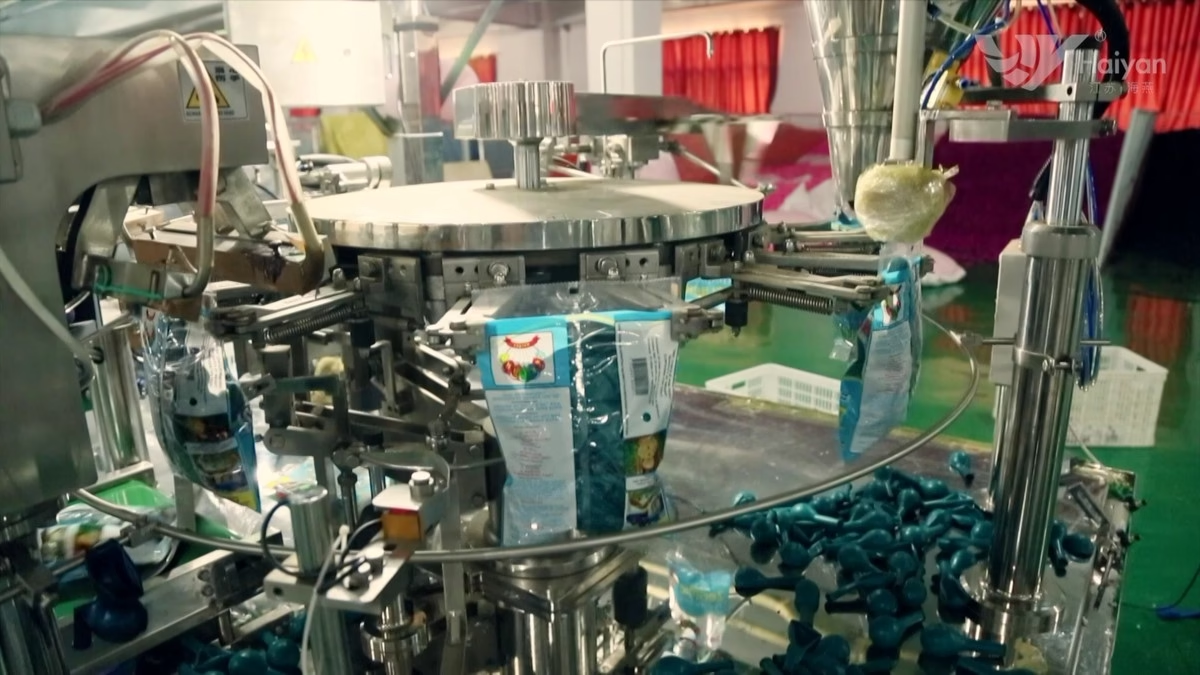
For mixed-SKU orders, show the value and carton contribution of each line. This prevents one small line from becoming operationally impractical while the total order value appears sufficient. It also exposes whether a color split creates too many partial cartons or whether a custom pack applies to only part of the order.
Use samples to approve scope, not replace MOQ
Samples help approve the order definition, but AIHUA sample availability, fee, freight, timing and any credit are case specific. They are not a universal free or low-quantity production route. Use the latex balloon sample-approval guide to record the product, version, conditions, result and buyer decision.
If a sample changes the size, color, finish, artwork, print position or packing plan, request an updated quotation before confirming MOQ. The approved sample should not silently change the design count or custom-packaging scope.
Calculate reorder timing from a documented stock trigger
Use a documented stock trigger rather than a fixed universal reorder interval. Start with average sales or consumption, peak-season factor, safety stock, approval time, production time from the current quote, transport time, customs/receiving time and the acceptable stockout risk. The result belongs to the buyer's market and logistics route.
A simple control is: projected stock at the next available arrival date should remain above the agreed safety stock. If not, start the next RFQ earlier. For printed or custom-packaging orders, include artwork and approval time. For mixed colors or sizes, calculate the trigger by SKU because the fastest-moving line may reach its threshold first.
Record MOQ scope in the current quotation
| Field | Required record | Why it matters |
|---|---|---|
| Scope | Regular, printed per design, custom packaging, or a documented combination. | Selects the correct boundary. |
| SKU split | Product, size, color/finish, design and line quantity. | Prevents an invalid mix assumption. |
| Packing | Bag count, bag version, carton count/mark and provisional/final status. | Connects MOQ to warehouse and freight. |
| Approvals | Artwork, sample and packaging version plus buyer decision. | Stops version drift. |
| Commercial timing | Current payment, production, shipment and validity terms. | Prevents a policy page from replacing the quote. |
For an order-specific answer, send the SKU list, destination, standard or custom packing choice, print design count and required arrival date through the AIHUA inquiry page. AIHUA can then state the applicable MOQ, accepted mix and quotation validity without turning an example into a universal promise.
Buyer FAQ
What minimum order applies to regular AIHUA latex balloons?
Regular goods start from a USD 5,000 order value. The accepted SKU, size, color/finish and packing mix must be confirmed in the current quotation.
What minimum order applies to printed AIHUA latex balloons?
Printed latex balloons start from 50,000 pieces per design. Different artworks, brands, languages or layouts may be treated as separate designs.
What minimum order applies to AIHUA custom packaging?
Custom packaging starts from a USD 10,000 order value. Bag format, artwork, barcode, warnings, count, seal and carton marks require an approved version.
Can a sample order replace the MOQ?
No universal replacement is promised. Sample availability, fee, freight, timing and any credit are confirmed case by case for the inquiry.
How should a buyer compare two MOQ offers?
Align product, size, weight or construction, SKU split, design count, packing, carton plan, approval work, destination and quotation validity before comparing total or unit cost.