Private-Label Balloon Packing: Artwork, MOQ, Carton and QC Checklist
We help wholesalers, balloon brands and retail chains sell latex balloons in their own packaging. You tell us the products, colour mix, bag quantity and packaging style. We prepare the layout, check it with you and keep the confirmed details for repeat orders. The whole order starts at US$5,000, with each specification at least one carton.
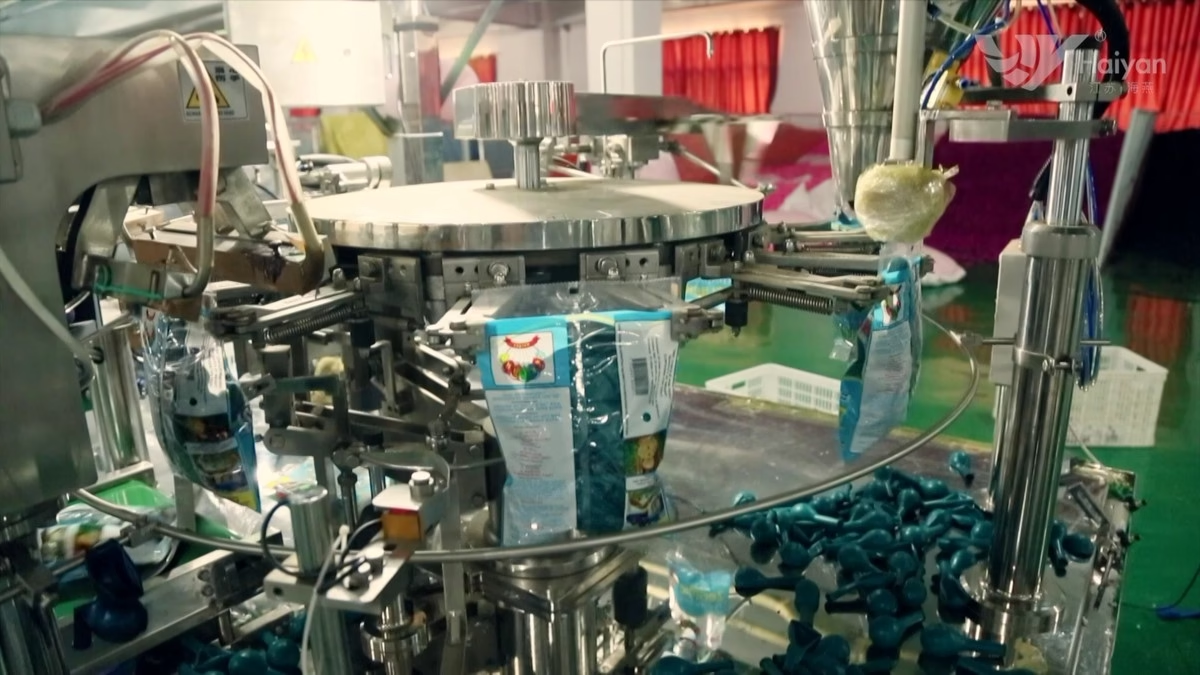
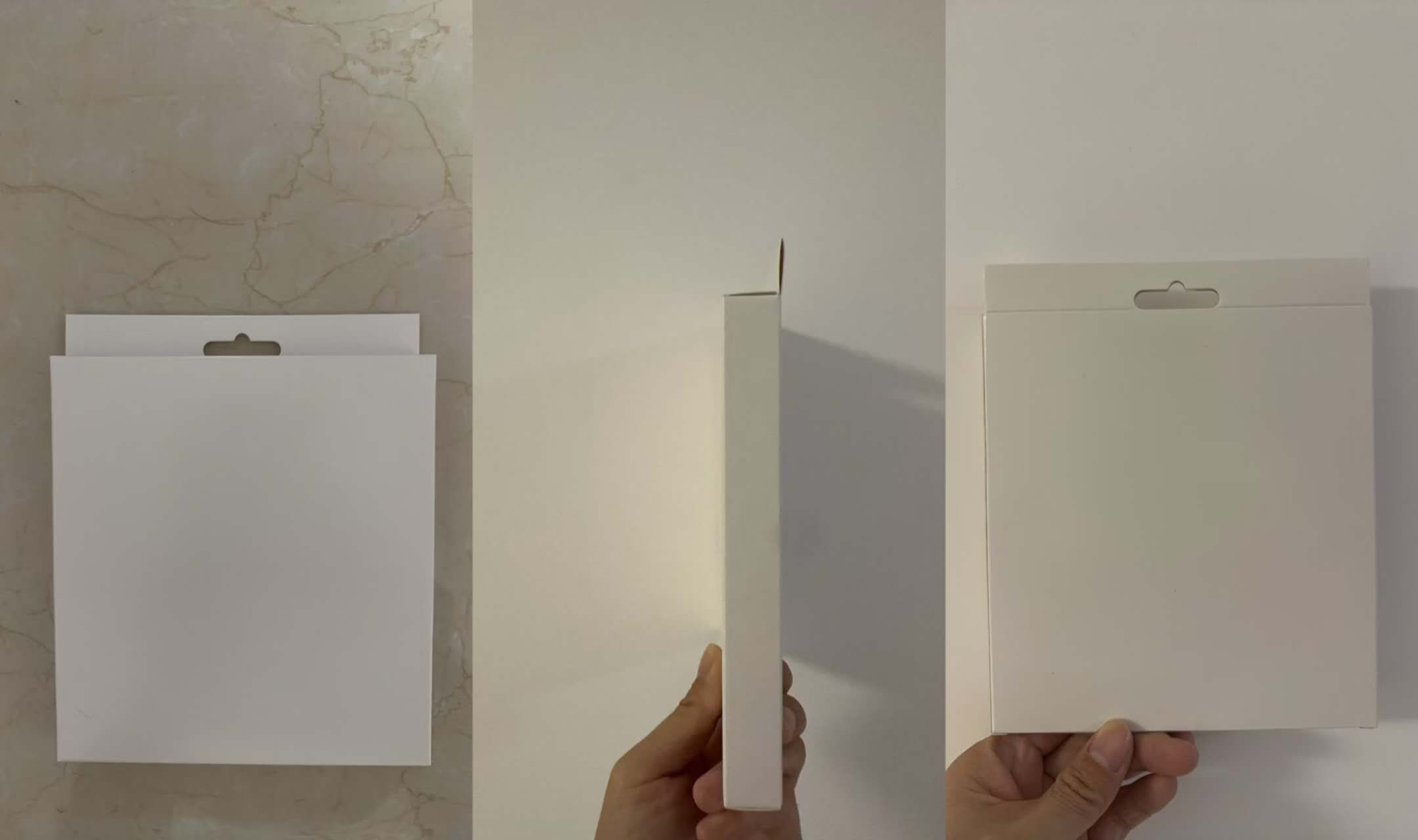
For brand owners and chain-store buyers: You can keep your own brand while we coordinate the balloon, colour mix, bag, header-card bag, paper box or display box around your sales channel. You provide the brand artwork, barcode and required warning text; we prepare the packaging layout and final design proof for approval. Packaging design and plate-making costs are included in the order quotation. If the product pictures in the original artwork are only computer composites, we can arrange real product photos to your requirements and send the finished design proof for confirmation before bulk production.
Payment and dispatch planning: The usual payment arrangement is 30% deposit and the balance before dispatch by bank T/T. After the deposit is received and the packaging artwork is approved, one full-container order is normally dispatched within 45 days and two full-container orders within 60 days; smaller conventional projects are usually planned within 30–45 days. This is dispatch time, not destination arrival time. FOB is the usual shipping basis, with the final port and forwarding arrangement confirmed in the quotation.
If you need help with individual details, see our bag, barcode and carton checklist, printed balloon options and wholesale ordering guide.
For your first pack, use the bag-proof checklist. If you are reordering or changing an existing pack, use the packaging change and repeat-order checklist.
MOQ and sample arrangements
The following boundaries help buyers decide which quotation path applies. They are planning thresholds, not a promise that every product, color, pack style or SKU mix can be combined. The current quotation and approved order file control the final scope. The whole order starts at US$5,000, and each specification must be at least 1 carton.
| Order path | Current planning boundary | What must still be quoted |
|---|---|---|
| Regular goods | Whole order starts at US$5,000; each specification at least 1 carton | Product range, sizes, colors, quantities, stock or production basis and packing |
| Printed latex balloons | From 50,000 pieces per design | Balloon specification, artwork, print scope, design count, sample path and packing |
| Custom packaging | Whole order starts at US$5,000; each specification at least 1 carton | Bag or box format, material, dimensions, print file, SKU count, labels, barcode and cartons |
| Samples | Ordinary samples free; buyer pays courier; printed physical sample normally US$100 | Sample type, purpose, availability, cost, freight, timing and approval use |
For quantity conversion and reorder planning, use the separate MOQ, carton and reorder guide. For sample decisions, use the sample approval guide.
Keep the approved product and packaging details together
Start the file with a project name, buyer, destination market, quotation reference, revision number and approval authority. Every later document should point back to that identity. A file called “final” is not enough when several artwork versions, languages or SKU lists have been exchanged.
| Record | Minimum fields | Release question |
|---|---|---|
| Product matrix | SKU, product type, size, color or finish, quantity and unit | Does every packing line refer to one defined product? |
| Artwork register | File name, revision, dimensions, language, date and approver | Is there one approved production version? |
| Retail-pack record | Pack type, quantity per pack, label panels, closure and visible SKU | Can warehouse staff identify the contents without opening the pack? |
| Carton record | Inner packs, carton quantity, marks, dimensions and recorded weights | Does the carton plan reconcile with the purchase order? |
| Release record | Approved sample or proof, packing photos, exceptions, approver and date | Is approval tied to the same revision and order scope? |
Artwork and brand permission
The buyer should own the artwork or have permission to use it. The approval file should identify the brand owner, the authorized file and the person who released it. AIHUA should not be asked to reproduce counterfeit branding, protected packaging or another seller’s distinctive product presentation.
A practical artwork register records the editable source, exported production file, color references, dimensions, print or label location, revision and approval date. If a logo, warning panel, language, barcode or product specification changes, the affected proof should return to review. Approval of one design does not automatically approve another design or another pack size.
SKU, barcode and destination-label control
The buyer remains responsible for supplying correct barcode data, brand text, importer or distributor information, destination-market language and any required warnings or claims. The supplier can place approved information into the quoted layout, but a packing proof is not legal advice and does not establish that a label satisfies every destination rule.
Record the barcode number as text as well as an image, link it to the correct SKU and check a test print at the intended size. Confirm the product description, quantity statement, color or assortment description and country or importer fields against the purchase order. This reduces the risk of a visually attractive bag being assigned to the wrong SKU.
Sample and change-control decisions
Samples are case specific because a stock product sample, a printed balloon sample, a packaging material mock-up and a finished private-label pack answer different questions. The quotation should state what the sample represents, what it does not represent, who pays the sample and freight costs, and whether another approval is required after a change.
Use a simple status for each element: pending, approved, approved with a recorded exception or rejected. Do not treat silence, a chat emoji or an old screenshot as release authority. If the buyer changes artwork, pack count, label language, barcode, product mix or carton configuration, update the revision and identify which approvals must be repeated.
Packing and shipment-release evidence
Before release, compare the approved record with evidence from the actual order. Depending on the quoted scope, the evidence file can include the front and back of the retail pack, seal or closure, SKU and barcode area, inner quantity, carton marks, carton count, recorded dimensions or weights, packing list and any approved exception. Evidence should carry the order or batch reference and capture date; a generic factory picture cannot substitute for order-specific packing evidence.
We check product quantities at least three times before dispatch and carry out at least three internal quality checks. You can also arrange a third-party inspection at the factory. For a repeat order, we retrieve the previous details and confirm them with you again before production.
RFQ package for an actionable quotation
Send a compact RFQ containing the buyer company, destination market, product SKUs, balloon specifications, quantity by SKU, artwork ownership, design count, pack format, quantity per pack, languages, barcode data, carton requirements, sample purpose and requested schedule. Mark unknown fields instead of guessing. Buyers can review the current AIHUA product routes and then use the AIHUA contact page to request a scoped quotation.
Buyer FAQ
Does AIHUA support private-label or OEM balloon packaging?
Yes. We can supply balloons in your own bags, header-card bags, paper boxes or display boxes. Send the product list and packaging requirements, and we will prepare a quotation and design proof.
What is AIHUA’s planning boundary for custom packaging?
Custom packaging follows the whole-order starting point of US$5,000, with each specification at least 1 carton. The final quotation still depends on the product, SKU mix, packaging format, artwork, labels, quantities and approval scope.
Is the printed-balloon threshold the same as the custom-packaging threshold?
No. For an order of one printed balloon product, the minimum is 50,000 pieces per design. Printed items in a larger mixed-product order can be discussed at smaller quantities. The whole order starts at US$5,000, with at least one carton per specification. Packaging and balloon printing are quoted according to the project.
Are private-label samples standard or free?
Ordinary samples are free and the buyer pays courier. A printed physical sample is normally quoted at US$100; US$50 can be deducted when an order is placed within 10 days. The quotation still defines the sample type, purpose, timing and approval use.
What should a buyer approve before private-label packing starts?
The buyer should approve a version-controlled record covering product SKUs, artwork, pack format, label text, barcode data, quantity per pack, carton plan, sample status, exceptions and release authority.